
The category mismatch problem
Every year, hundreds of solar companies invest significant time and money in Salesforce or HubSpot solar CRM implementations, only to arrive at the same conclusion 6–18 months later: the platform can be configured to approximate some of what a solar company needs, but the gap between “approximates” and “actually works” is measured in hundreds of hours of configuration, tens of thousands of dollars in professional services, and a persistent residue of workarounds that never fully goes away.
The problem is not that Salesforce and HubSpot are bad products. They are exceptional products within their category. The problem is that their category – enterprise sales and marketing automation – is not the category that solar companies need. This is a category mismatch problem, not a product quality problem.
The distinction matters because it changes the solution. If the problem were product quality, the answer would be to find a better-quality generic CRM. But if the problem is category mismatch, the answer is to find a product in the right category – one built for the operational model of a solar EPC company rather than for the operational model of a B2B software company.
What generic CRMs were designed to do
To understand why generic CRMs fail for solar operations, you need to understand what they were actually designed to do. Salesforce was founded in 1999 to serve enterprise B2B sales organisations – companies where salespeople manage large portfolios of accounts, move deals through complex multi-stakeholder approval processes and need deep integration with marketing, customer success and finance teams. Every design decision in Salesforce reflects this origin. The data model, the workflow engine, and the reporting architecture – all of it is optimised for the relationship management and pipeline visibility needs of enterprise B2B sales.
HubSpot was founded to serve a different version of the same model: inbound marketing-driven growth for SMB and mid-market companies. Its core strength is the flywheel from marketing lead generation through CRM pipeline management to customer success. The integration between marketing automation, lead scoring, email sequences and deal management is exceptional – and it is exceptional specifically for companies that generate leads digitally and close them through a relatively straightforward sales conversation.
Both platforms have since expanded beyond their original categories – Salesforce into operations, service management and industry clouds; HubSpot into operations and service tools. But these expansions are additive layers on top of an architecture that was designed for a fundamentally different operational model.
The solar business model vs the SaaS business model
The deepest reason generic CRMs fail for solar is the structural difference between the solar business model and the B2B SaaS business model for which most CRMs are optimised.
In a B2B SaaS business, the product cycle looks like this: lead captures through marketing → qualification through sales conversation → proposal (which is a pricing table, not a component-level bill of quantities) → contract signature → customer success/account management → renewal. The “product” is software that is delivered digitally and requires no physical installation. There is no supply chain, no warehouse, no installation crew, no grid connection, no regulatory approval process.
In a solar EPC business, the product cycle looks like this: lead capture → site survey → technical assessment → BOQ generation with component-level calculations → proposal → contract signature → procurement release → material reservation and delivery → civil and mechanical installation → electrical installation and testing → commissioning and grid connection → handover documentation → ongoing service and maintenance. The “product” is a physical energy system that is engineered, procured, installed and commissioned over weeks or months.
These are not superficially different business models with the same underlying operational needs. They are categorically different businesses that happen to share a small number of common elements – notably the lead-to-signed-contract phase. Configuring a Salesforce instance to handle the first five steps of the solar cycle is achievable. Configuring it to handle material planning, crew scheduling, milestone billing and service ticket management is a fundamentally different engineering challenge – one that typically requires a specialist implementation partner, significant ongoing admin overhead and a series of compromises that leave the most operationally critical features half-built.
Where generic CRMs break for solar operations
The following six gaps are not theoretical. They are the specific capability failures that solar companies report when they describe why their Salesforce or HubSpot implementation is not working for them.
Gap 1: No BOQ or solar proposal generation
Salesforce has CPQ (Configure, Price, Quote) – a powerful quoting tool designed for SaaS subscription pricing, professional services rate cards and product catalogue-based quoting. It is excellent for what it was designed for. It is not a solar BOQ generator.
Solar BOQ generation requires component-level quantity calculations driven by engineering parameters: panel count is a function of system capacity divided by panel wattage, adjusted for string configuration compatibility. Cable quantity is a function of measured routing lengths with a wastage factor. Mounting hardware quantity depends on roof type and panel layout. BOS component selection depends on system topology and local regulatory requirements. None of these calculations can be performed by a generic quoting tool without significant custom development — and the custom development required to approximate a solar BOQ in Salesforce CPQ typically costs $15,000–$40,000 and still produces a system that is harder to use and maintain than a purpose-built BOQ tool.
HubSpot’s quote functionality is more limited than Salesforce CPQ and even less suitable for solar BOQ generation. Solar companies using HubSpot typically maintain their BOQ process in Excel alongside HubSpot, using the CRM for pipeline management and the spreadsheet for the technical and commercial elements of the proposal.
Gap 2: No project milestone management
Both Salesforce and HubSpot track opportunities through stages. An opportunity moves from “Qualified” to “Proposal Sent” to “Negotiation” to “Closed Won.” This is deal stage tracking – it tells you where a prospect is in the sales process. It does not tell you that the mounting structure installation is 60% complete, that the DC wiring milestone is waiting on a cable delivery that is two days late, and that this delay will push the commissioning date back by four days, which will require rescheduling the utility inspection that was booked for Friday.
This is the difference between a CRM and a project management system. Generic CRMs track deals – they do not manage project execution. For solar EPC companies, the transition from “deal closed” to “project executing” is the most operationally demanding phase of the entire business cycle. It is where costs are incurred, where errors are made, where client trust is won or lost, and where margin is either protected or eroded. Managing this phase in the same tool as pipeline management requires a project management capability that does not exist in either Salesforce or HubSpot without significant custom development or third-party integration.
Gap 3: No inventory or materials management
The complete absence of inventory management in both Salesforce and HubSpot is the most operationally damaging gap for solar EPCs and dealers. Managing panels, inverters and cables across multiple warehouses, linking material availability to project BOQs, reserving stock for committed projects, tracking consumption against the BOQ plan and managing stock replenishment – none of this is possible within the core Salesforce or HubSpot platform.
The consequence is parallel systems: a CRM for pipeline management and a separate inventory spreadsheet or standalone ERP for materials. These parallel systems are never fully synchronised. The CRM shows the deal as committed; the inventory system shows the materials as available. But between these two systems, nobody is checking whether the materials reserved for this project are actually available at the warehouse where the project is starting next Monday, because the systems do not talk to each other.
Gap 4: No vendor procurement module
Vendor management – maintaining an approved supplier list, sending requests for quotation, raising purchase orders linked to project BOQs, tracking deliveries, recording vendor payments and managing credit notes – is entirely outside the scope of both Salesforce and HubSpot. Solar companies managing their vendor relationships through these platforms do so by treating vendors as a type of “Contact” or “Company” record, with vendor POs tracked in spreadsheets or separate procurement software.
This disconnection between the project BOQ (which specifies what needs to be procured) and the vendor procurement system (which manages the procurement) means that procurement decisions are made without live visibility of the project scope, and project execution decisions are made without live visibility of procurement status. The project manager does not know that the inverter delivery has been delayed. The procurement coordinator does not know that the installation date has been moved forward. Both of these gaps are direct causes of the material-related project delays that account for 40% of solar EPC schedule overruns.
Gap 5: No field crew tools
The Salesforce Mobile app and the HubSpot mobile app are designed for salespeople managing their contact lists and updating deal stages from their phones. They are not designed for installation technicians on a commercial roof who need to check in at the job site with GPS verification, view their task list for the day, photograph each completed installation phase linked to the correct project milestone, log equipment serial numbers for warranty registration and flag a safety issue to their supervisor.
Solar companies that attempt to use Salesforce or HubSpot mobile for field crew management consistently find that the field crew simply stops using the system within two to three weeks — not because they are resistant to technology, but because the tool was not designed for their use case and requires more effort than the alternative, which is sending a WhatsApp message.
Gap 6: No local market depth
Both Salesforce and HubSpot are American products built primarily for American business operations. Solar companies in India need GST-compliant invoicing with HSN codes. Solar companies in the UAE need VAT-compliant invoicing with TRN numbers and multi-currency billing across AED, SAR and QAR. Solar companies in Australia need DNSP milestone tracking and STC documentation support. Solar companies in the UK need DNO G98/G99 notification milestones and MCS certification compliance tracking. Solar companies in Germany need EEG documentation and Marktstammdatenregister registration tracking.
None of these local market requirements can be addressed within a standard Salesforce or HubSpot implementation without custom development or regional configuration work that adds significantly to implementation cost and timeline.
What solar-specific CRM provides
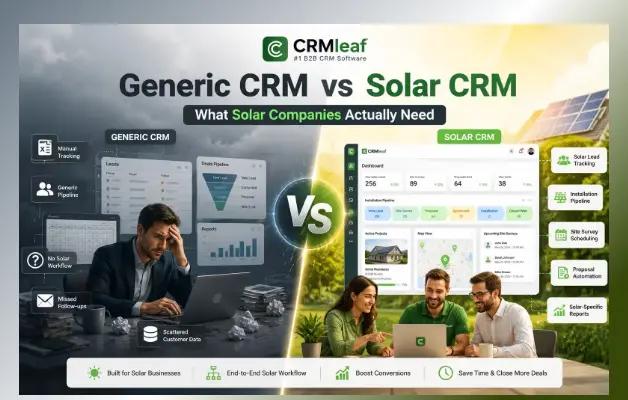
A vertical CRM built for solar does not attempt to compete with Salesforce on enterprise CRM breadth or with HubSpot on marketing automation depth. It provides the complete operational platform for the specific workflows that define solar business operations, designed around how solar companies actually work rather than how B2B software companies work.
The capability set that distinguishes a purpose-built solar CRM:
- Solar-specific pipeline stages that reflect how solar deals actually move – Survey Scheduled, Survey Completed, BOQ In Progress, BOQ Under Approval, Proposal Sent, Negotiation, Won, Lost – rather than generic B2B stages
- Structured digital site survey forms that capture solar-specific data and feed BOQ generation directly, without manual re-entry
- BOQ auto-generation from a maintained product catalogue – panel count, cable lengths, inverter sizing, BOS components, mounting and labour calculated from system parameters
- Internal approval workflow that routes the BOQ to the correct approver via mobile notification, with version history and comment tracking
- Branded proposal generation from the approved BOQ, with client-specific savings estimates, payment schedules and mobile e-signature
- Auto-created project on deal win – no manual data handoff from sales to operations
- Project milestones matching installation phases – with tasks, crew assignment, dependency rules, billing triggers and completion photo requirements
- Multi-warehouse inventory management – linked to BOQs, with stock reservation, consumption tracking and low-stock alerts
- Vendor procurement module – RFQ, PO creation linked to project BOQ, delivery tracking, vendor payment and credit note management
- Field crew mobile app – geo check-in, task completion, milestone photos, offline capability
- Milestone billing automation – invoice auto-created when milestone is marked complete by the field crew
- Local market support – GST/VAT invoicing, multi-currency, regional regulatory milestone templates
The hidden cost of supplementing a generic CRM
One of the clearest measures of the gap between what a generic CRM provides and what a solar company needs is the number of additional tools the company runs alongside it. In the data from SolarCRM customers who switched from Salesforce or HubSpot, the average number of separate software tools running in parallel with the CRM was 6.8.
These tools typically include: an Excel-based BOQ template, a Word or PowerPoint proposal template, a separate project management tool (Asana, Monday, Trello), a WhatsApp group structure for field coordination, an inventory spreadsheet, a vendor payment tracking spreadsheet, and an invoicing tool. Each of these tools requires its own license, its own maintenance, its own data entry and its own learning curve for new team members.
The total cost of this fragmented stack – licenses, admin time, data re-entry time and the cost of errors from information that is not synchronised between systems – typically exceeds the cost of a purpose-built solar platform by a factor of 3–5×. The generic CRM might cost $50/user/month while providing a fraction of the operational value of a $50/user/month solar-specific platform.
Build vs configure vs adopt vertical software
When solar companies recognise that their generic CRM is not meeting their operational needs, they typically consider three responses: build a custom solution, configure the existing platform more deeply, or adopt a vertical software platform built for solar.
Building a custom solution – either on top of a platform like Salesforce or from scratch – is the most expensive option and the one most likely to result in a system that is perpetually behind business needs. Custom software requires ongoing engineering resources to maintain, update and extend. It is also the option most likely to create a key-person dependency: the system works because one developer understands it, and if that developer leaves, the system becomes unmaintainable.
Configuring the existing platform more deeply is the default response for most companies, because it feels like the path of least resistance – “we have already invested in this platform, let us get more out of it.” The problem is that deeper configuration on a platform with architectural limitations does not overcome the architectural limitations. It compounds the complexity and the maintenance burden without solving the fundamental gaps.
Adopting a vertical platform built for solar is the option that most companies arrive at after trying one or both of the above alternatives. The economic argument is simple: the total cost of ownership for a purpose-built solar platform – subscription cost plus the eliminated cost of supplementary tools, custom development, ongoing admin and data re-entry – is typically lower than either alternative. The time-to-value is dramatically shorter: operational in 2-5 days versus 3-6 months for a Salesforce implementation. And the ongoing maintenance burden is zero – the platform vendor maintains the software while the customer uses it.
How to evaluate whether your current CRM fits
If you are currently using a generic CRM and wondering whether it is adequate for your solar operations, the following five questions provide a reliable diagnostic:
- Does your CRM generate a BOQ from site survey data without manual re-entry into Excel? If the answer is no, you are spending 2-8 hours per proposal on a task that should take 2 minutes.
- Does your CRM track project milestone completion in real time, without status calls? If the answer is no, your project manager is spending 60–90 minutes per day collecting information that should be available on a dashboard.
- Does your CRM automatically create a client invoice when a project milestone is marked complete? If the answer is no, you are missing 8–12% of your monthly billing in delayed or forgotten invoices.
- Do your field crews use your CRM’s mobile app on-site for task updates and attendance? If the answer is no, your project dashboard is always out of date and you have no geo-verified record of who was at each site on each day.
- Does your CRM track inventory across warehouses and raise vendor POs for BOQ shortfalls? If the answer is no, you are managing materials manually and absorbing the cost of over-ordering, under-ordering and emergency procurement regularly.
If the answer to three or more of these questions is no, you are operating with a tool that was not designed for your business model. The cost of that mismatch – in time, errors, missed revenue and operational fragility – is real and it is accruing every month. The question is not whether to evaluate alternatives. The question is how much longer the status quo is sustainable.
Conclusion: the vertical software shift is underway
The economics of vertical software have changed significantly in the past decade. A generation ago, industry-specific software often meant compromised functionality at a premium price – built by companies that understood the industry but lacked the engineering resources to match the quality of general-purpose tools. That dynamic has reversed. Purpose-built platforms for solar, construction, healthcare, logistics and other verticals now deliver engineering quality that matches or exceeds general-purpose tools, with domain specificity that general-purpose tools cannot economically replicate.
For solar companies that have been told “Salesforce can do everything you need if you configure it correctly,” the honest answer is: it can approximate most of what you need, at significant configuration cost and with persistent gaps in the areas that matter most operationally. A purpose-built solar platform does not require that configuration – it arrives with the solar model embedded, from the first site survey form to the last milestone invoice.
The choice is not between a powerful generic platform and a limited solar-specific tool. It is between a powerful tool built for a different industry that requires expensive customisation to approximate solar operations, and a purpose-built tool that was designed for exactly the operations you need to run.