

In 2025, over 70% of small and mid-sized businesses fail to meet growth targets not because of lack of effort—but because of lack of visibility. Leaders often realize problems only after revenue drops, costs spike, or customers churn. By the time monthly reports are reviewed, the damage is already done.
This is the core challenge modern SMBs face: decisions are being made with outdated data. Spreadsheets, disconnected software, and manual reports simply cannot keep pace with today’s fast-moving operations. As markets become more competitive, businesses that rely on hindsight are being outperformed by those that operate in real time.
This is why real-time business KPIs have become non-negotiable. They give leaders instant clarity on what is working, what is failing, and where immediate action is required.
In this blog, you will learn which business KPIs every SMB should track in real time, why they matter across departments, and how a unified CRM + ERP platform like CrmLeaf helps you monitor, analyze, and act — without complexity.
Business Need & Importance
Modern SMBs operate in an environment where speed, accuracy, and coordination directly impact profitability. However, many businesses still manage sales, HR, finance, projects, and inventory in silos. As a result, leaders lack a single source of truth.
Here is why tracking real-time business KPIs is critical today:
- Rising operational complexity: As teams grow and processes scale, manual tracking becomes error-prone. Without real-time KPIs, inefficiencies remain hidden until they turn into financial losses.
- Higher customer expectations: Customers expect faster responses, accurate billing, and consistent service. Therefore, delayed insights directly affect customer satisfaction and retention.
- Cost pressure and margin volatility: Inflation, supply chain disruptions, and labor costs demand tighter financial control. Real-time KPIs enable proactive cost management instead of reactive firefighting.
Industry examples:
- Manufacturing: Without real-time production, inventory, and rejection-rate KPIs, manufacturers face overstocking, stockouts, and quality issues that erode margins.
- Retail & Distribution: Delayed visibility into sales velocity and inventory turnover leads to lost revenue and excess carrying costs.
- Services & Projects: When utilization and project cost KPIs are not tracked in real time, businesses suffer from overruns, delayed billing, and reduced profitability.
This is why spreadsheets and disconnected tools no longer work. SMBs need automated, integrated systems where KPIs update instantly across departments. A unified CRM platform ensures every stakeholder sees the same numbers – at the same time.
Best Practices, Frameworks & Actionable Tips
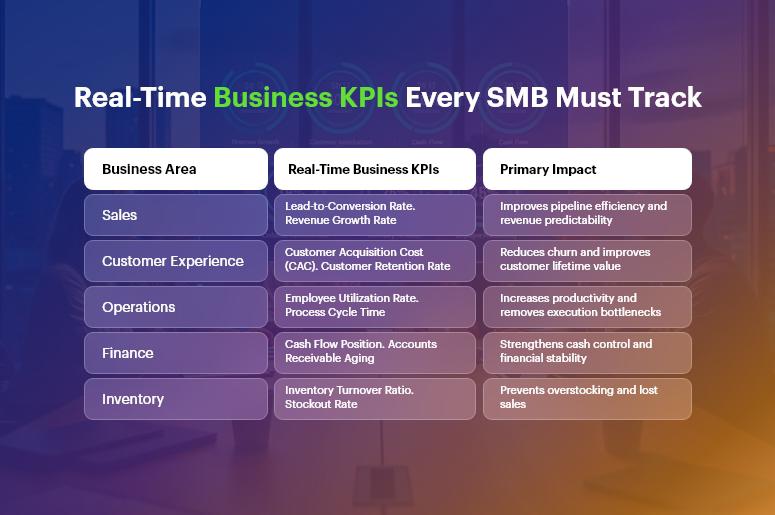
Core Real-Time Business KPIs Every SMB Must Track
1. Sales & Revenue KPIs
- Lead-to-Conversion Rate: Tracks how efficiently leads turn into customers. Real-time visibility helps sales managers intervene early and optimize pipelines.
- Revenue Growth Rate: Shows whether growth strategies are working. Monitoring this daily prevents surprises at month-end.
- Average Deal Value: Highlights upselling and pricing effectiveness, especially when integrated with CRM opportunity data.
2. Customer Experience KPIs
- Customer Acquisition Cost (CAC): Real-time CAC helps marketing teams control spend and improve ROI.
- Customer Retention Rate: Indicates loyalty and service quality. Sudden drops signal operational or support issues.
- Ticket Resolution Time: Ensures service teams meet SLAs and maintain customer trust.
3. Operations & Productivity KPIs
- Employee Utilization Rate: Measures productive time vs. available time, crucial for service and project-based businesses.
- Process Cycle Time: Tracks how long key workflows take, enabling continuous improvement.
- Task Completion Rate: Provides managers visibility into execution discipline across teams.
4. Financial KPIs
- Cash Flow Position: Real-time cash visibility protects SMBs from liquidity shocks.
- Operating Margin: Reveals profitability after core expenses, helping leaders adjust quickly.
- Accounts Receivable Aging: Prevents delayed collections from impacting working capital.
5. Inventory & Supply Chain KPIs
- Inventory Turnover Ratio: Shows how efficiently stock moves, reducing carrying costs.
- Stockout Rate: Helps prevent lost sales due to poor planning.
- Order Fulfillment Time: Directly impacts customer satisfaction and repeat business.
Best Practices for Implementing Real-Time KPI Tracking
- Define KPIs aligned with business goals: Avoid vanity metrics. Every KPI should influence decisions and outcomes.
- Limit KPIs per role: Executives, managers, and teams need different dashboards for clarity and focus.
- Automate data collection: Manual inputs delay insights and increase errors.
- Review KPIs daily, not monthly: Real-time business KPIs are only valuable when acted upon quickly.
Do’s and Don’ts
Do:
- Centralize data across CRM, HRMS, finance, and operations.
- Set thresholds and alerts for critical KPIs.
- Train teams to interpret KPI trends, not just numbers.
Don’t:
- Track too many KPIs without accountability.
- Rely on static reports.
- Ignore cross-departmental dependencies.
Why a Unified CRM + ERP Is the Superior Solution
A unified platform like CrmLeaf eliminates data silos by connecting:
- CRM: Real-time sales pipelines, conversions, and customer insights.
- HRMS & Payroll: Live workforce costs, attendance, and productivity.
- Manufacturing & Inventory: Production efficiency, stock levels, and quality metrics.
- Projects: Utilization, timelines, and cost tracking.
- Finance: Instant visibility into cash flow, margins, and receivables.
As a result, real-time business KPIs become actionable, accurate, and trusted across the organization.
Customer Success
A mid-sized manufacturing and distribution business, implemented real-time KPI dashboards using CrmLeaf to solve fragmented reporting and delayed decision-making.
Before CrmLeaf, their sales, production, inventory, and finance teams worked in separate systems. Monthly reports took days to compile, and inventory mismatches often caused missed deliveries.
Within 90 days of implementing CrmLeaf’s unified CRM platform, achieved measurable results:
- 25% reduction in inventory carrying costs through real-time stock visibility
- 18% improvement in on-time order fulfillment by tracking production KPIs live
- 30% faster management decisions with real-time business KPI dashboards
- Significant reduction in manual reporting effort, saving over 40 hours per month
By aligning sales forecasts, production planning, and financial KPIs in one system, the company transformed from reactive management to proactive control.
Key Takeaways & Closing
In today’s fast-paced environment, visibility equals control. SMBs that rely on delayed reports are constantly reacting, while those tracking real-time business KPIs stay ahead of problems and opportunities.
By monitoring sales, customer, operations, financial, and inventory KPIs in real time, businesses gain the clarity needed to scale confidently. More importantly, when these KPIs are connected across departments, leaders can make decisions that are faster, smarter, and more profitable.
As 2025 demands agility and accountability, unified platforms like CrmLeaf are no longer optional—they are foundational. The future belongs to businesses that can see, decide, and act in real time.
FAQs
1. What are real-time business KPIs?
Real-time business KPIs are performance metrics that update instantly as data changes, allowing SMBs to make immediate and informed decisions.
2. Why are real-time business KPIs important for SMBs?
They help SMBs detect issues early, improve efficiency, control costs, and respond faster to market changes.
3. How many KPIs should an SMB track?
Most SMBs should track 10–20 real-time business KPIs, tailored by role and department, to avoid information overload.
4. Can spreadsheets handle real-time KPI tracking?
Spreadsheets lack automation and integration, making them unsuitable for accurate real-time business KPI tracking at scale.
5. How does CrmLeaf support real-time KPI monitoring?
CrmLeaf unifies CRM, HR, finance, inventory, and projects into one platform, delivering live KPI dashboards without manual effort.
6. Are real-time KPIs expensive to implement?
With unified platforms like CrmLeaf, SMBs can implement real-time business KPIs without heavy IT costs or complexity.
7. Which KPI should SMBs prioritize first?
Cash flow, revenue pipeline, and customer retention KPIs are typically the most critical starting points for SMBs.