

Customer expectations have fundamentally changed. Today, customers expect instant responses, personalized interactions, and consistent support across every channel. However, as businesses scale, traditional customer service models struggle with rising ticket volumes, fragmented tools, and reactive workflows.
As a result, AI in Customer Service Management has emerged as a critical solution. Instead of relying solely on manual processes, organizations now use artificial intelligence to modernize Customer Service Management (CSM) and deliver faster, smarter, and more proactive support.
Moreover, AI is no longer an experimental add-on. On the contrary, it has become a core operational layer that enables service teams to work efficiently while meeting growing customer expectations.
Rising Expectations and Growing Support Complexity
Customers now interact with brands through email, live chat, social media, in-app messaging, and self-service portals. At the same time, service teams must:
- Maintain low response times
- Deliver personalized customer support
- Control operational costs while scaling
However, manual workflows and rule-based systems cannot keep up with this complexity. Consequently, AI-driven Customer Service Management has shifted from optional to essential.
Why Traditional Customer Service Management Fails to Scale
Traditional Customer Service Management relies heavily on human intervention. While this approach works at a small scale, it quickly breaks down as volume and complexity increase.
Key challenges include:
- Reactive support models that address issues only after escalation
- Manual ticket triaging, which causes delays and SLA breaches
- Limited visibility into customer sentiment and recurring problems
- Knowledge silos that slow down resolution times
Because of these limitations, teams feel overwhelmed, customers become frustrated, and operational costs continue to rise. Therefore, organizations increasingly turn to AI in Customer Service Management to overcome these challenges.
How AI Transforms Modern Customer Service Management
AI transforms Customer Service Management by embedding intelligence across the entire service lifecycle. Importantly, AI does not replace human agents. Instead, it augments teams with automation, insights, and predictive capabilities.
1. AI-Powered Chatbots and Virtual Assistants
AI chatbots handle repetitive, high-volume customer queries such as FAQs, order tracking, and account-related questions. Unlike rule-based bots, modern AI assistants learn from conversations and continuously improve.
Outcomes include:
- 24/7 customer support availability
- Faster first-response times
- Reduced workload for service agents
2. Intelligent Ticket Classification and Routing
AI automatically categorizes tickets, detects urgency, and routes them to the most suitable agents based on expertise and availability.
As a result:
- Resolution times decrease
- Agent utilization improves
- SLA compliance increases
3. Sentiment Analysis and Context Awareness
AI analyzes tone, language, and intent to identify frustrated or high-risk customers in real time.
Therefore, teams can:
- Escalate issues proactively
- Improve customer experience (CX)
- Reduce churn risk
4. Predictive Customer Support
By analyzing historical data, AI identifies patterns that predict repeat issues, product friction, and potential churn.
Consequently:
- Teams engage customers proactively
- Repeat tickets decline
- Customer retention improves
5. AI-Driven Knowledge Management
AI continuously updates knowledge bases and recommends relevant articles to both agents and customers.
This leads to:
- Faster self-service adoption
- Consistent answers across channels
- Reduced reliance on senior agents
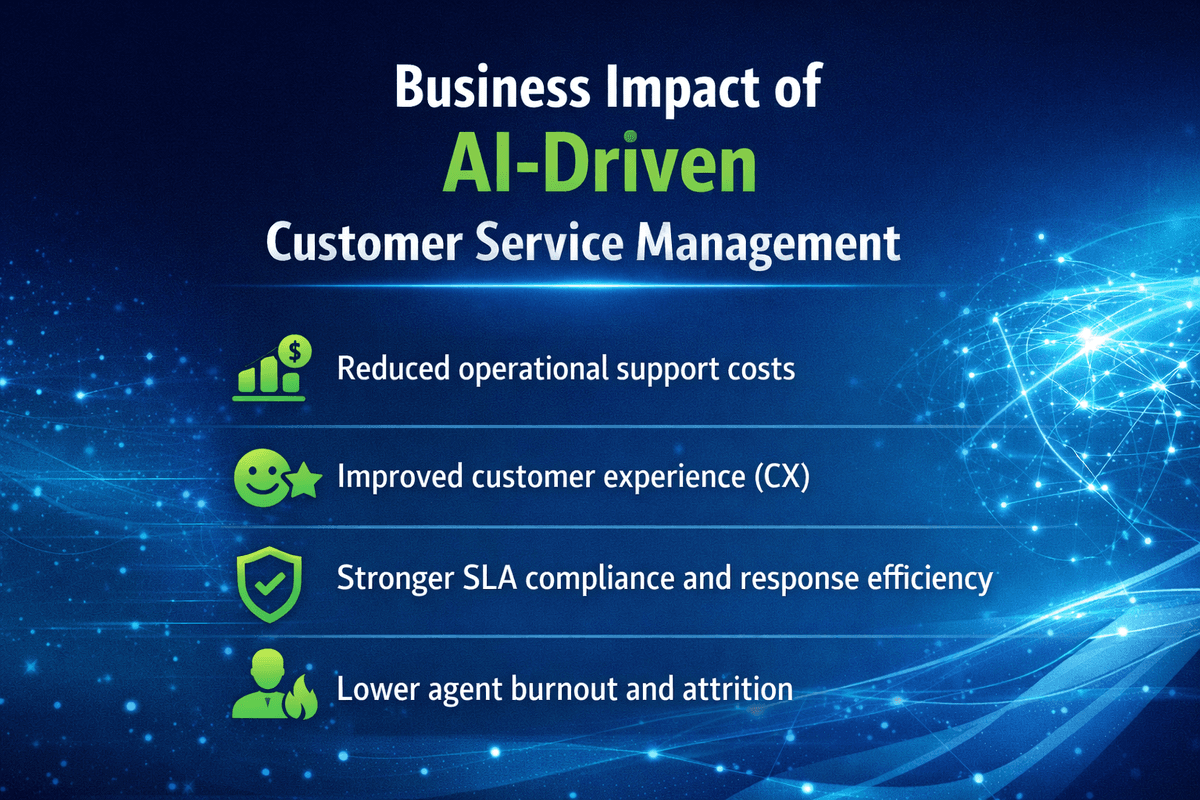
Business Impact of AI in Customer Service Management
When implemented correctly, AI in Customer Service Management delivers measurable results across cost, experience, and productivity.
Cost Efficiency
- Lower cost per ticket
- Reduced dependency on headcount growth
- Optimized resource allocation
Customer Experience (CX)
- Faster response and resolution times
- Personalized and contextual support
- Consistent omnichannel experiences
Team Productivity
- Agents focus on complex, high-value issues
- Reduced burnout and attrition
- Improved performance insights
Where AI Fits in Real Customer Service Teams
Successful adoption of AI in Customer Service Management follows a phased and practical approach:
- Start with automation – Chatbots, ticket tagging, and routing
- Layer in intelligence – Sentiment analysis and intent detection
- Move to prediction – Churn signals and proactive support
- Continuously optimize – Improve workflows using AI insights
Most importantly, AI must integrate seamlessly with existing CRM and helpdesk systems instead of operating in isolation.
The Future of Customer Service Management: Predictive and Proactive
The future of Customer Service Management is not just faster — it is anticipatory. Moving forward, AI will:
- Predict customer needs before issues arise
- Recommend next-best actions for agents
- Automatically surface product feedback
- Enable hyper-personalized service journeys
Ultimately, Customer Service Management will evolve from a cost center into a strategic growth driver.
Optimization and Repurposing Strategy
To maximize ROI, teams should repurpose this content across multiple growth channels:
- LinkedIn Carousel: “5 Ways AI Transforms Customer Service”
- Short Video: AI chatbot vs human agent comparison
- Email Newsletter: AI-driven CX insights
- Sales Collateral: AI capability explainer
- Webinar: “Scaling Customer Service with AI”
As a result, messaging stays consistent across awareness, consideration, and conversion stages.
Performance Tracking: Measuring What Matters
SEO Metrics
- Organic traffic growth
- Keyword rankings for AI + CSM terms
- Click-through rate (CTR)
Engagement Metrics
- Time on page
- Scroll depth
- Bounce rate
Business and CX Metrics
- Demo requests influence
- Assisted conversions
- Reduction in support-related churn
- AI feature interest from leads
Collaboration with Growth, Sales, and Product Teams
AI-focused Customer Service Management content performs best when teams collaborate cross-functionally:
- Growth teams reuse insights for ad copy, retargeting, and landing pages
- Sales teams share the blog with AI-curious and late-stage prospects as pre-demo education
- Product teams validate feature messaging and identify roadmap gaps based on customer questions
Thus, content becomes a revenue-enabling asset, not just an SEO initiative.
Ideal Daily Output for a Growth-Driven Writer
A sustainable, high-impact cadence includes:
- 1 long-form blog per day (1,800–2,500 words), or
- 1 pillar blog plus 2–3 repurposed assets (carousel, video script, email)
This approach balances authority building, demand generation, and long-term organic growth.
Final Thoughts
The role of AI in Customer Service Management extends far beyond automation. It enables scalable operations, proactive engagement, and data-driven decision-making. Consequently, organizations that adopt AI strategically reduce support costs while delivering experiences that build loyalty and long-term growth.
The real question is no longer whether AI belongs in customer service — but how quickly you can make it work for your teams and customers.