
Most businesses don’t fail because they lack customers.
Instead, they fail because their operations can’t keep up with growth.
In today’s business environment, companies aren’t struggling with opportunity. On the contrary, they are struggling with complexity.
Sales teams work inside one tool. Meanwhile, support teams use another. Operations still rely on spreadsheets. Finance tracks numbers elsewhere. As a result, leadership spends more time stitching reports together than making decisions.
This is exactly why traditional sales-only CRMs are no longer enough. Modern businesses need a Unified CRM Platform
— a single system that connects sales, operations, support, finance, and management into one continuous operating model.
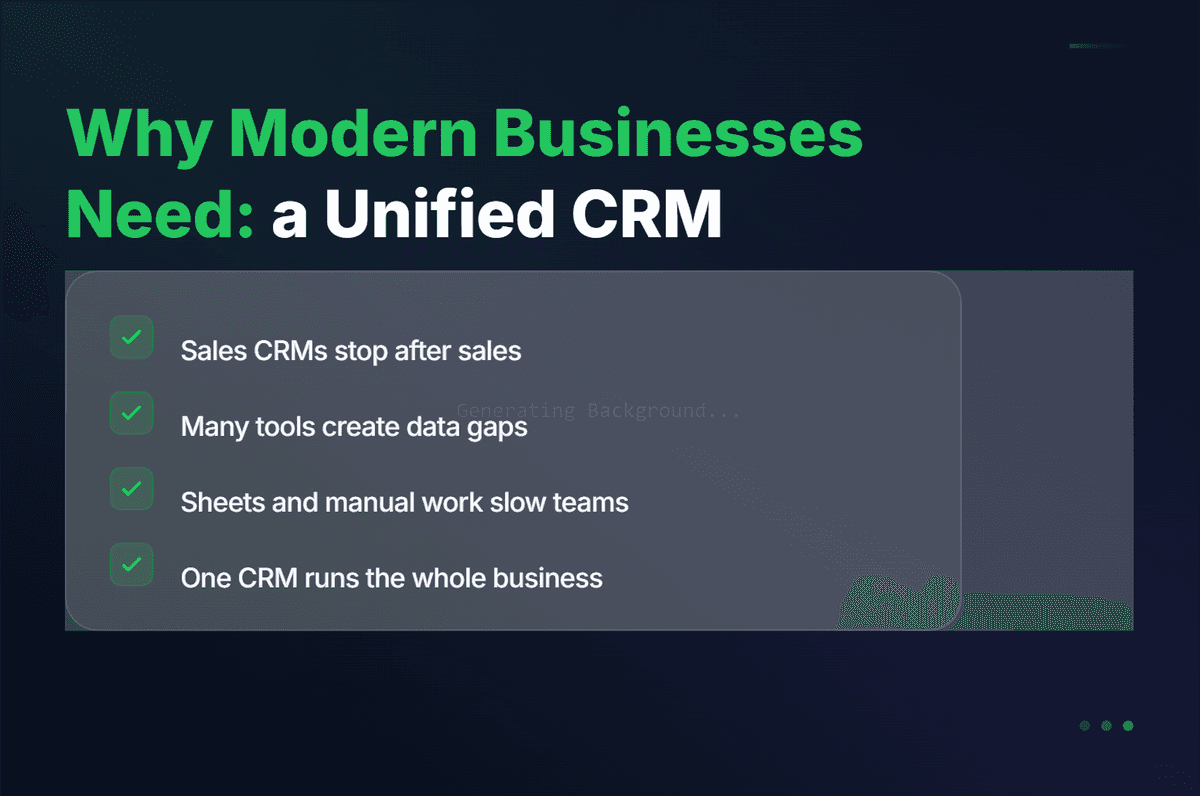
In this guide, you’ll learn:
- What a Unified CRM Platform really means
- Why sales CRMs are no longer sufficient
- The hidden problems caused by disconnected systems
- What changes when you unify your CRM at an organizational level
- And how platforms like CrmLeaf represent the next generation of CRM
What Is a Unified CRM Platform?
A Unified CRM Platform is not just a tool for managing leads and deals.
Instead, it acts as a central operating system for the entire business.
It brings together:
- Sales
- Customer onboarding
- Operations and delivery
- Support and service
- Reporting and management visibility
- Workflow automation
- Data and process governance
As a result, every team works on the same platform, the same data, and the same processes.
Instead of switching tools or updating spreadsheets, teams collaborate inside one connected system. Consequently, execution becomes faster, cleaner, and far more predictable.
The Problem With Traditional Sales CRMs
Most CRMs were built with one primary goal: help sales teams close deals.
And yes, they do this well.
Sales CRMs are good at:
- Lead management
- Opportunity tracking
- Sales pipelines
- Revenue forecasting
However, modern businesses don’t stop working after the deal is closed.
In reality, that’s when the real work begins.
After sales, teams must handle:
- Customer onboarding
- Delivery and implementation
- Support and service
- Billing and invoicing
- Renewals and expansions
Unfortunately, most sales CRMs stop at “Closed Won.”
Because of this limitation, companies end up using:
- One sales CRM
- One project or operations tool
- One support system
- Separate accounting software
- And dozens of spreadsheets
As a result, businesses create fragmentation, duplication, delays, and blind spots—without even realizing it.
Why Disconnected Systems Are Killing Business Efficiency
1. Data Silos Break Decision-Making
When data lives in multiple tools:
- Sales numbers don’t match finance numbers
- Operations lack customer context
- Leadership never sees a real-time picture
Consequently, every meeting turns into:
“Whose data is correct?”
A Unified CRM Platform eliminates this confusion by creating a single source of truth across the organization.
2. Team Handoffs Become Failure Points
In most companies, the flow looks like this:
- Sales closes the deal
- Someone emails or WhatsApps operations
- Another person updates a spreadsheet
- Support gets informed later
Because of this, teams experience:
- Missed commitments
- Lost context
- Delays in delivery
- Poor customer experience
However, a unified CRM transforms handoffs into automated, trackable workflows. As a result, nothing falls through the cracks.
3. Process Inconsistency Becomes Normal
Without a single system:
- Every team follows its own process
- Every manager runs things differently
- Quality depends on individuals, not systems
Over time, this inconsistency creates chaos.
In contrast, a Unified CRM Platform standardizes execution across the organization. Consequently, outcomes become predictable and repeatable.
4. Leadership Loses Real Control
When systems remain fragmented, leadership depends on:
- Manual reports
- Status meetings
- Excel consolidations
- Lagging indicators
However, with a unified CRM:
- Leaders see real-time operations
- Decisions rely on live data
- Risks surface early
In short, leadership manages systems — not meetings.
What a Unified CRM Platform Actually Solves
Let’s break this down clearly.
1. Manages the Entire Customer Lifecycle
A Unified CRM Platform covers the complete journey:
- Lead → Opportunity → Deal
- Deal → Onboarding → Delivery
- Delivery → Support → Renewal
- Renewal → Expansion → Upsell
Because everything lives inside one connected system:
- No context gets lost
- No team works blindly
- Customer experience stays consistent
As a result, businesses scale without breaking execution.
2. Connects Sales, Operations, and Support
Instead of working in isolation:
- Sales sees delivery capacity
- Operations see what was sold and promised
- Support sees full customer history
- Management sees the entire picture
This alignment removes friction and improves execution across teams.
3. Replaces Spreadsheets and Manual Tracking
Most operational chaos comes from:
- Excel trackers
- Google Sheets
- WhatsApp coordination
- Manual follow-ups
- Centralizes all work
- Automates workflows
- Makes execution system-driven, not people-dependent
As a result, businesses reduce errors and improve speed.
4. Builds Process Discipline Into the Business
With a unified platform:
- Every deal follows the same flow
- Every project follows defined stages
- Every support case follows SLA rules
This creates:
- Predictability
- Quality control
- Scalable execution
5. Enables Real Automation Across Departments
True automation means more than notifications.
A Unified CRM enables:
- Automatic task creation
- Automated approvals
- Seamless handoffs
- SLA-based escalations
- Real-time reporting
Unlike sales-only CRMs, a Unified CRM orchestrates workflows across the entire business.
6. Gives Leadership a Real-Time Control Tower
With unified data, leadership gains visibility into:
- Sales performance
- Delivery status
- Support workload
- Revenue pipelines
- Risks and bottlenecks
All of this lives in one system, updated in real time.
Why This Matters More in 2026 and Beyond
Modern businesses face:
- Tighter margins
- Higher customer expectations
- Faster execution cycles
- Intense competition
- Less tolerance for inefficiency
You cannot scale with:
- Fragmented tools
- Manual coordination
- Human-dependent controls
Instead, you must scale with systems.
The New Role of CRM: From Sales Tool to Business Operating System
CRM is no longer:
- “A tool for sales teams”
Today, it is becoming:
- “The central nervous system of the company”
This is exactly where platforms like CrmLeaf fit.
CrmLeaf isn’t built just to track sales. Instead, it helps businesses run operations, workflows, and the entire customer lifecycle from one unified platform.
Unified CRM Platform vs Sales CRM: A Simple Comparison
| Sales CRM | Unified CRM Platform |
| Manages leads and deals | Manages the full business lifecycle |
| Used mainly by sales | Used by sales, ops, support, and management |
| Limited automation | End-to-end workflow automation |
| Stops after deal closure | Continuous lifecycle management |
| Sales-focused reporting | Company-wide operational visibility |
Who Needs a Unified CRM Platform the Most?
- Growing SMBs scaling beyond 20–50 people
- Service-based companies
- SaaS businesses
- Manufacturing and delivery-driven organizations
- Any company where execution matters as much as selling
Final Thought: Tools Don’t Scale Businesses. Systems Do.
If your company still runs on:
- Multiple disconnected tools
- Spreadsheets
- Manual coordination
Then you’re not running a system. You’re running organized chaos.
A Unified CRM Platform isn’t just a software upgrade. It’s an operating model upgrade.
And that’s exactly why modern businesses don’t need just a sales CRM anymore. They need a Unified CRM Platform.
FAQs
1. What is a Unified CRM Platform?
A Unified CRM Platform is a single system that manages the entire customer lifecycle — from leads and sales to onboarding, operations, support, renewals, and reporting.
2. How is a Unified CRM different from a Sales CRM?
A Sales CRM focuses on deals and pipelines. A Unified CRM connects sales, operations, support, workflows, and management into one system.
3. Why are sales-only CRMs no longer enough?
Because modern businesses must manage onboarding, delivery, service, and retention — not just selling.
4. What problems does a Unified CRM solve?
It removes data silos, reduces manual handoffs, standardizes processes, improves visibility, and enables automation.
5. Which teams use a Unified CRM?
Sales, operations, support, finance, and leadership all use the same platform.
6. Is a Unified CRM only for large enterprises?
No. Growing SMBs benefit the most because unified systems reduce chaos as teams scale.
7. Can a Unified CRM replace multiple tools?
Yes. It replaces sales tools, project trackers, support systems, and spreadsheets.
8. How does a Unified CRM improve customer experience?
Every team sees the full customer history, which prevents miscommunication and delays.
9. What kind of automation does a Unified CRM offer?
It automates tasks, approvals, handoffs, escalations, SLAs, and reporting across departments.
10. How does CrmLeaf support the Unified CRM approach?
CrmLeaf connects sales, operations, workflows, and customer lifecycle management into one unified system.