
Modern HR teams face a growing challenge. On one hand, employees expect faster responses, greater transparency, and more control over their information. On the other hand, HR professionals struggle with repetitive queries, manual updates, and administrative overload.
Fortunately, employee self-service portals solve both problems at once.
By giving employees direct access to their HR information, self-service portals empower the workforce while significantly reducing HR workload. As a result, HR teams shift their focus from routine tasks to strategic initiatives.
In this blog, we’ll explore how employee self-service portals work, why they matter, and how they transform HR operations in today’s digital-first organizations.
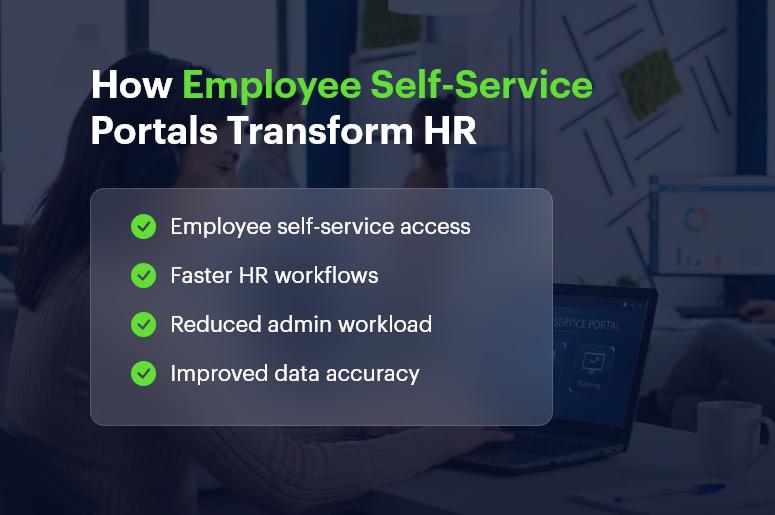
What Is an Employee Self-Service Portal?
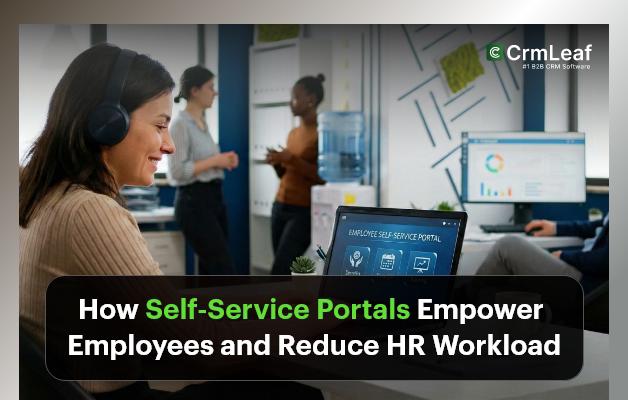
An employee self-service portal (ESS) is a centralized digital platform where employees can access, update, and manage their HR-related information independently.
Instead of contacting HR for every request, employees can log in and handle tasks on their own. Consequently, HR teams experience fewer interruptions and faster process completion.
Typically, an employee self-service portal includes access to:
- Personal and employment details
- Payslips and tax documents
- Leave and attendance records
- Benefits and policy documents
- Requests and approvals
- Company announcements and updates
Because everything stays in one place, both employees and HR benefit from clarity and consistency.
Why Traditional HR Models No Longer Scale
Before self-service portals, HR departments relied heavily on emails, spreadsheets, and manual records. While this approach worked for smaller teams, it quickly breaks down as organizations grow.
As a result:
- HR teams spend hours answering the same questions
- Errors occur due to duplicate data entry
- Employees experience delays and frustration
- Strategic HR initiatives get deprioritized
Therefore, businesses need a smarter, more scalable approach. This is exactly where HR self-service portals step in.
How Self-Service Portals Empower Employees
1. Employees Gain Control Over Their Information
First and foremost, self-service portals put employees in charge.
Instead of submitting requests to update personal details, employees can edit information themselves. Consequently, data stays accurate and up to date at all times.
This autonomy builds trust. Moreover, it reduces dependency on HR for simple updates.
2. Faster Access to Payroll and HR Information
Employees often need immediate access to payslips, tax forms, or attendance records. However, manual sharing causes delays.
With a self-service portal:
- Employees download payslips instantly
- Tax documents remain available year-round
- Attendance and leave balances update in real time
As a result, employees feel informed, confident, and supported.
3. Transparent Leave and Attendance Management
Leave management often creates friction. Employees wonder about balances, approvals, and policies.
Self-service portals eliminate confusion by:
- Showing real-time leave balances
- Allowing leave requests in a few clicks
- Displaying approval status instantly
Therefore, transparency improves while misunderstandings disappear.
4. Improved Employee Experience and Satisfaction
When employees don’t have to wait for HR responses, satisfaction increases naturally.
Additionally, self-service portals create a modern, digital experience that aligns with employee expectations. Over time, this improves engagement, retention, and overall workplace morale.
How Self-Service Portals Reduce HR Workload
1. Fewer Repetitive Queries
One of the biggest drains on HR time involves repetitive questions like:
- “Can you resend my payslip?”
- “What’s my leave balance?”
- “How do I update my bank details?”
Self-service portals answer these questions instantly. As a result, HR teams spend far less time responding to routine emails.
2. Reduced Manual Data Entry
Manual data entry leads to errors, rework, and wasted effort.
However, when employees update their own information:
- Data accuracy improves
- Duplicate records disappear
- HR avoids constant corrections
Therefore, HR operations become cleaner and more reliable.
3. Faster Approvals and Workflow Automation
Self-service portals often integrate automated workflows for approvals.
For example:
- Leave requests route automatically to managers
- Approvals trigger instant updates in payroll
- Notifications keep everyone informed
Consequently, processes move faster with minimal HR involvement.
4. Better Compliance and Documentation
Compliance requires accurate records and clear audit trails.
Self-service portals help HR by:
- Maintaining digital records automatically
- Tracking changes and approvals
- Ensuring policy acknowledgments
As a result, audits become easier and compliance risks decrease.
The Role of Self-Service Portals in HR Automation
Employee self-service portals are a foundational element of HR automation.
When integrated with HRMS and payroll systems, they create a seamless ecosystem where data flows automatically. Therefore, HR teams gain real-time visibility without constant manual intervention.
Moreover, automation allows HR to focus on:
- Talent development
- Performance management
- Employee engagement strategies
- Workforce planning
In short, self-service portals free HR from operational noise.
Key Features to Look for in an Employee Self-Service Portal
To maximize impact, businesses should choose a portal that includes:
- Intuitive and mobile-friendly interface
- Secure access and role-based permissions
- Payroll, attendance, and leave integration
- Custom workflows and approvals
- Real-time notifications and alerts
- Centralized document management
When these features come together, both employees and HR teams experience immediate benefits.
How Self-Service Portals Support Digital HR Transformation
Digital HR transformation isn’t just about adopting software. Instead, it’s about changing how HR operates.
Self-service portals:
- Promote self-reliance and accountability
- Standardize HR processes across teams
- Improve data-driven decision-making
- Support remote and hybrid work environments
Therefore, they act as a catalyst for long-term HR modernization.
Final Thoughts
Employee self-service portals fundamentally change the HR–employee relationship.
By empowering employees with direct access to their information, organizations improve transparency, speed, and satisfaction. At the same time, HR teams reduce administrative workload, improve accuracy, and reclaim time for strategic initiatives.
In today’s fast-growing, digital-first workplaces, self-service portals are no longer optional—they are essential.
If your HR team still relies on manual processes, now is the time to make the shift and unlock the true potential of HR automation.
Frequently Asked Questions (FAQs)
1. What is an employee self-service portal?
An employee self-service portal is a digital platform that allows employees to access and manage HR-related information such as payslips, leave balances, attendance, and personal details without depending on HR. As a result, employees gain autonomy while HR teams reduce manual effort.
2. How does an employee self-service portal reduce HR workload?
Employee self-service portals reduce HR workload by eliminating repetitive queries, minimizing manual data entry, and automating approvals. Consequently, HR teams spend less time on administrative tasks and more time on strategic initiatives.
3. What HR tasks can employees manage through a self-service portal?
Employees can manage tasks such as updating personal information, downloading payslips, applying for leave, tracking attendance, accessing policies, and submitting requests. Therefore, HR no longer needs to intervene in routine activities.
4. Is employee data secure in a self-service portal?
Yes, modern HR self-service software uses secure login protocols, role-based access, and encryption. As a result, sensitive employee and payroll data remains protected while still being easily accessible to authorized users.
5. How does a self-service portal improve employee experience?
A self-service portal improves employee experience by offering instant access to information, transparent workflows, and faster approvals. Moreover, employees feel empowered when they control their own HR interactions.
6. Can self-service portals integrate with payroll and HRMS systems?
Yes, most HRMS self-service portals integrate seamlessly with payroll, attendance, and core HR systems. Therefore, any updates made by employees reflect automatically across connected systems.
7. Are employee self-service portals suitable for small businesses?
Absolutely. In fact, self-service portals help small businesses scale efficiently by reducing HR dependency early. Consequently, even lean HR teams can manage growing workforces with ease.
8. How do self-service portals support compliance and audits?
Self-service portals maintain digital records, approval trails, and document acknowledgments automatically. As a result, HR teams can ensure compliance and prepare for audits without last-minute stress.
9. Do self-service portals support remote and hybrid employees?
Yes, self-service portals support remote and hybrid work environments by providing anytime, anywhere access to HR information. Therefore, location no longer limits employee engagement or HR efficiency.
10. What features should I look for in an employee self-service portal?
You should look for features such as mobile accessibility, secure access, payroll and leave integration, automated workflows, notifications, and centralized document storage. When these features work together, both employees and HR teams benefit significantly.