

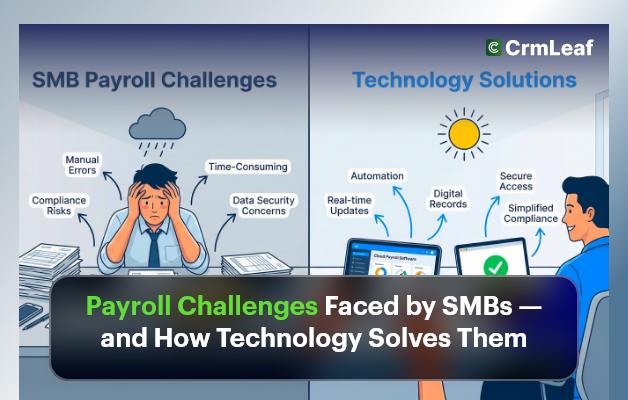
Running a business is hard. However, SMB payroll often becomes harder than it should be. Every month, small and mid-sized businesses fight the same battle: calculating salaries, handling deductions, managing compliance, fixing errors, and answering employee questions. Meanwhile, leadership teams want to focus on growth, not spreadsheets.
Unfortunately, payroll is still one of the most underestimated operational risks inside growing companies. As businesses scale, payroll complexity grows faster than headcount. Therefore, companies that do not modernize SMB payroll early eventually face compliance penalties, unhappy employees, cash flow stress, and operational chaos.
In this complete guide, you will learn:
- Why payroll becomes a bottleneck as companies grow
- The biggest payroll challenges SMBs face today
- The hidden cost of manual payroll operations
- How modern payroll technology fixes each problem systematically
- What a future-ready SMB payroll system should look like
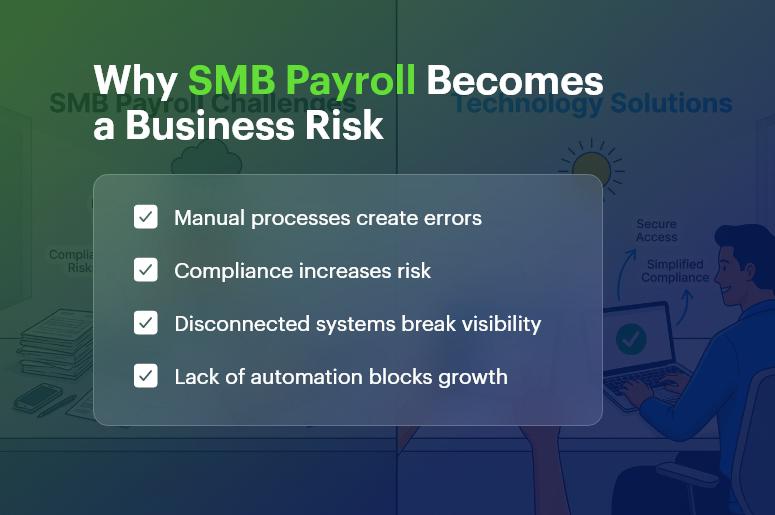
Why SMB Payroll Is More Complex Than It Looks
On the surface, payroll looks simple: calculate salaries and pay people. However, in reality, payroll sits at the intersection of:
As a result, even a small mistake in SMB payroll can trigger:
- Legal penalties
- Employee dissatisfaction
- Audit failures
- Reputation damage
- Cash flow mismanagement
Moreover, every new hire, regulation, location, or benefit policy increases payroll complexity.
Therefore, payroll is no longer an administrative task. It is a core business system.
The 12 Biggest SMB Payroll Challenges (And Why They Keep Growing)
Let us break down the real challenges that destroy efficiency inside payroll operations.
1. Manual Calculations and Spreadsheet Dependency
Many SMBs still run payroll using:
- Excel sheets
- Email approvals
- Handwritten attendance data
- Manual adjustments
This creates:
- Calculation errors
- Version control issues
- No audit trail
- No real-time visibility
As a result, payroll becomes slow, fragile, and risky.
2. Compliance With Ever-Changing Regulations
Compliance is the biggest landmine in SMB payroll.
SMBs must handle:
- Income tax
- PF, ESI, PT (or regional equivalents)
- Minimum wage laws
- Overtime rules
- Bonus and gratuity laws
- Payslip regulations
- Filing deadlines
However:
- Laws change frequently
- Rules vary by region
- Penalties are severe
Therefore, manual SMB payroll becomes a legal risk, not just an operational one.
3. Payroll Errors That Destroy Employee Trust
Even one mistake in payroll can:
- Delay salaries
- Overpay or underpay employees
- Break trust
- Create HR escalations
- Damage morale
Common errors include:
- Wrong attendance data
- Incorrect deductions
- Missed incentives
- Tax miscalculations
Moreover, once employees lose trust in payroll, every salary cycle becomes a conflict.
4. Time-Consuming Payroll Processing Cycles
Most SMBs spend:
- 2–5 days per month preparing payroll
- Additional days fixing errors
- Even more time answering employee questions
This means:
- HR teams waste strategic time
- Finance teams lose focus
- Leadership loses visibility
As a result, SMB payroll becomes a recurring productivity drain.
5. Poor Integration With Attendance, HR, and Accounting
Disconnected systems kill payroll accuracy.
Typical SMB stack:
- Attendance in one tool
- HR data in another
- Accounting in another
- Payroll in spreadsheets
This causes:
- Data mismatches
- Manual imports
- Reconciliation errors
- No single source of truth
Therefore, SMB payroll becomes an error factory.
6. Cash Flow and Salary Planning Issues
Without forecasting and visibility, payroll creates:
- Last-minute fund shortages
- Panic payments
- Delayed salaries
- Broken planning cycles
Moreover, many SMBs do not know:
- Their real payroll liability
- Upcoming increments impact
- Bonus cycle exposure
7. Scalability Breaks the System
What works for 10 employees breaks at 50.
What works at 50 breaks at 200.
As companies grow, payroll must handle:
- Multiple departments
- Multiple salary structures
- Multiple locations
- Multiple compliance regimes
Manual systems collapse under this complexity.
8. Data Security and Confidentiality Risks
Payroll data contains:
- Salaries
- Bank details
- Identity information
- Tax information
However, spreadsheet-based SMB payroll usually has:
- No access control
- No audit logs
- No encryption
- No breach protection
This creates serious legal and reputational risk.
9. No Audit Trail or Historical Intelligence
Most SMBs cannot answer:
- Who changed salary data?
- When was it changed?
- Why was it changed?
- What was the impact?
Without audit trails, SMB payroll becomes legally dangerous.
10. Employee Self-Service Is Missing
Employees want:
- Payslips
- Tax documents
- Leave balances
- Investment declarations
Without self-service:
- HR becomes a helpdesk
- Payroll teams waste time
- Employees remain frustrated
11. Year-End Tax and Compliance Panic
For most SMBs, year-end means:
- Data chaos
- Missing records
- Filing stress
- Auditor pressure
- Last-minute fixes
This happens because SMB payroll data was never structured properly.
12. Hidden Cost of Manual Payroll Operations
Manual payroll looks cheap. However, it costs:
- Staff time
- Error corrections
- Compliance penalties
- Opportunity cost
- Leadership distraction
In reality, it is one of the most expensive inefficiencies inside SMB operations.
How Technology Solves Every SMB Payroll Problem Systematically
Now let us look at how modern payroll platforms fix these issues permanently.
1. Full Payroll Automation
Modern systems:
- Auto-calculate salaries
- Auto-apply rules
- Auto-generate payslips
- Auto-run deductions
As a result:
- Zero manual math
- Zero calculation errors
- Faster payroll cycles
2. Built-In Compliance Engine
Modern SMB payroll software:
- Updates tax rules automatically
- Applies statutory limits correctly
- Generates compliant reports
- Alerts for deadlines
Therefore, compliance becomes automatic, not stressful.
3. Real-Time Integration With HR, Attendance, and Finance
A proper payroll system connects:
- Attendance systems
- Leave management
- HR records
- Accounting systems
This ensures:
- Single source of truth
- No manual imports
- No reconciliation errors
4. Error Elimination Through Rule Engines
Rule-based payroll systems:
- Enforce policies automatically
- Prevent invalid entries
- Validate salary structures
- Flag anomalies before processing
As a result, payroll accuracy becomes predictable and reliable.
5. Built-In Audit Trails and Version Control
Modern SMB payroll platforms track:
- Who changed what
- When it changed
- Why it changed
- What it affected
This makes audits simple and safe.
6. Self-Service Portals for Employees
Employees can:
- Download payslips
- Submit declarations
- View tax reports
- Check leave and attendance
This reduces HR workload and improves employee experience.
7. Advanced Payroll Analytics and Forecasting
Smart payroll systems show:
- Monthly payroll liability
- Department-wise cost
- Increment impact simulation
- Bonus cycle planning
This turns payroll from an expense into a planning tool.
8. Enterprise-Grade Security
Modern payroll platforms offer:
- Role-based access
- Data encryption
- Secure backups
- Compliance with data laws
This protects the most sensitive business data.
9. Scales Without Breaking
A modern SMB payroll system handles:
- 10 employees or 10,000
- One location or many
- One entity or multiple
Without changing processes.
10. Year-End Becomes a Button Click
With structured data, payroll systems:
- Generate tax forms automatically
- Produce audit-ready reports
- Simplify filings
- Eliminate year-end chaos
What a Future-Ready SMB Payroll System Must Include
If you are evaluating or building payroll, it must include:
- Automated salary computation
- Built-in statutory compliance
- Attendance and HR integration
- Self-service employee portal
- Audit logs and access control
- Payroll analytics and forecasting
- Secure cloud architecture
- Multi-location and multi-policy support
Anything less will break as you scale.
The Strategic Impact of Fixing SMB Payroll
When payroll works perfectly:
- Employees trust the company
- HR teams focus on strategy
- Finance teams gain visibility
- Leaders gain control
- Compliance risk disappears
- Operations become predictable
In other words, payroll becomes a business advantage, not a burden.
Final Thoughts: SMB Payroll Is No Longer Optional Infrastructure
In today’s environment, payroll is not a back-office function. It is:
- A compliance engine
- A trust system
- A financial control layer
- A scaling foundation
Companies that modernize SMB payroll early grow faster, operate cleaner, and sleep better.
Companies that delay it eventually pay the price—in penalties, chaos, and lost credibility.
The choice is no longer whether to modernize SMB payroll.
The only question is how soon.