

Payroll is one of the most sensitive operational functions in any organization. Every month, businesses must calculate salaries, apply taxes, manage deductions, ensure compliance, and generate payslips. However, when these processes depend on spreadsheets and manual work, errors become unavoidable.
That is why payroll automation is no longer optional. Instead, it has become a foundational business system. More importantly, payroll automation does not only speed up payroll. It also reduces errors, enforces compliance, saves operational costs, improves employee trust, and strengthens financial control.
In this complete guide, you will understand:
- What payroll automation really is
- Why manual payroll fails at scale
- How payroll automation reduces errors
- How payroll automation saves money
- What features matter
- How to calculate ROI
- How to implement it correctly
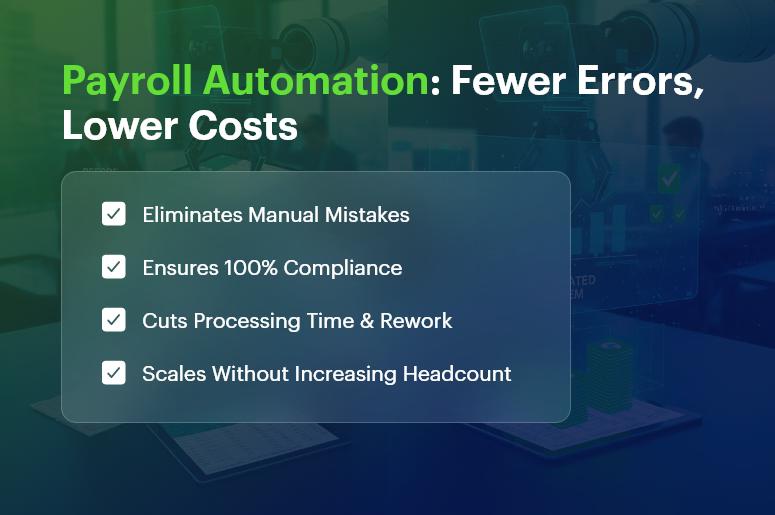
What Is Payroll Automation?
Payroll automation is the use of software to run payroll using predefined rules, workflows, and validations instead of manual calculations and spreadsheets.
In practice, payroll automation:
- Calculates salaries automatically, which removes human dependency and ensures consistent results.
- Applies tax and statutory rules, so compliance stays accurate even when regulations change.
- Manages deductions and benefits, which prevents calculation mismatches across employees.
- Generates payslips instantly, reducing processing time and employee queries.
- Creates compliance reports, making audits and filings predictable and reliable.
As a result, payroll becomes a controlled system instead of a recurring operational risk.
Why Manual Payroll Fails in Growing Businesses
Manual payroll might work at a very small scale. However, as soon as complexity increases, the system starts breaking down.
- Data entry mistakes happen because humans repeatedly copy and paste sensitive numbers.
- Formula errors occur because spreadsheets change every month and rarely get audited.
- Compliance rules get missed because regulatory updates rely on memory and manual tracking.
- Approval workflows break because emails and messages do not create accountability.
- Audit trails disappear because manual systems cannot track who changed what and when.
Therefore, manual payroll always creates hidden operational and financial risk.
How Payroll Automation Reduces Errors
Payroll errors exist because systems rely on memory and manual checking. Payroll automation replaces both logic and controls.
1. Eliminates Manual Data Entry
- Automatically pulls attendance, leave, and overtime data, which prevents typing and copy-paste errors.
- Syncs employee master data across systems, so mismatches between HR and payroll disappear.
- Removes duplicate work, which directly reduces human mistakes and processing time.
2. Uses Rule-Based Calculations
- Applies salary structures uniformly, which ensures two employees with the same structure always get the same result.
- Calculates taxes and deductions automatically, so formula mistakes never occur.
- Prevents broken spreadsheets, which are one of the biggest sources of payroll errors.
3. Built-in Validation and Error Checks
- Flags missing or incorrect data before payroll runs, which stops errors before they reach employees.
- Detects abnormal salary changes, which prevents accidental overpayments or underpayments.
- Blocks incomplete payroll runs, ensuring no partial or incorrect processing happens.
4. Automatic Compliance Updates
- Updates statutory rules centrally, so teams do not need to track every regulatory change manually.
- Applies new rates and limits automatically, which prevents outdated calculations.
- Reduces regulatory risk, because compliance becomes system-driven instead of memory-driven.
5. Full Audit Trails and Logs
- Records every change in employee data, which creates accountability and traceability.
- Tracks every payroll adjustment, which simplifies internal and statutory audits.
- Stores approval and processing history, which makes investigations and reviews easy.
Together, these controls eliminate entire categories of payroll errors.
How Payroll Automation Saves Operational Costs
The biggest savings from payroll automation come from efficiency, not just software cost.
1. Reduces Payroll Processing Time
- Cuts payroll cycles from days to hours, which frees teams for higher-value work.
- Automates repetitive steps, which removes operational bottlenecks.
- Speeds up approvals and reporting, which improves overall business responsiveness.
2. Cuts Rework and Correction Costs
- Prevents salary disputes, which reduces time spent on support and escalations.
- Avoids reprocessing payroll, which saves both effort and system resources.
- Reduces correction entries, which also simplifies accounting and compliance.
3. Lowers Compliance and Penalty Risk
- Prevents late or wrong filings, which avoids fines, interest, and legal notices.
- Ensures accurate statutory reports, which reduces audit stress and remediation work.
- Decreases dependency on consultants, which directly lowers recurring advisory costs.
4. Reduces Headcount Pressure
- Allows one payroll executive to handle more employees, which improves team productivity.
- Prevents linear growth of payroll staff, even as the company scales.
- Shifts payroll teams from clerical work to control and governance roles.
5. Improves Cash Flow Planning
- Produces accurate salary and tax forecasts, which improves financial predictability.
- Prevents surprise adjustments, which stabilizes monthly cash planning.
- Strengthens budgeting accuracy, which improves overall financial discipline.
Hidden Costs of Not Using Payroll Automation
Manual payroll looks cheap on the surface, but it creates invisible costs.
- Time spent fixing mistakes slowly becomes more expensive than automation itself.
- Time spent answering employee queries reduces productivity of HR and finance teams.
- Time spent preparing reports increases because nothing is available in real time.
- Penalties and notices add direct financial loss and management stress.
- Loss of employee trust increases attrition and internal friction.
Core Features to Look for in Payroll Automation
A strong payroll automation system must include:
- Salary structure and rule engine, so calculations stay consistent and scalable.
- Attendance and leave integration, so payroll always uses real working data.
- Statutory compliance engine, so filings and deductions stay accurate.
- Auto-generated payslips and reports, so manual work disappears.
- Audit logs and role-based access, so control and security remain intact.
How Payroll Automation Improves Employee Experience
Payroll directly affects trust. Payroll automation strengthens that trust.
- Ensures salaries arrive on time, which builds confidence in the organization.
- Makes payslips clear and consistent, which reduces confusion and questions.
- Improves transparency of deductions, which prevents disputes and suspicion.
- Speeds up query resolution, because data is always available and traceable.
Payroll Automation and Compliance
Compliance today is continuous, not annual.
- Automatically applies laws and thresholds, which prevents outdated calculations.
- Tracks deadlines and reports, which ensures nothing gets missed.
- Keeps audit-ready records, which reduces legal and regulatory exposure.
How to Calculate ROI of Payroll Automation
You can measure ROI using:
- Time saved per payroll cycle, which converts directly into salary cost savings.
- Reduction in errors and disputes, which saves rework and management time.
- Reduction in penalties and audit effort, which lowers compliance cost.
- Improved scalability, which avoids future hiring in payroll operations.
How to Implement Payroll Automation Successfully
- Map your current payroll process, so you understand where risk and waste exist.
- Choose a system with strong compliance coverage, especially for your country.
- Migrate data carefully, because payroll accuracy depends on clean master data.
- Run parallel payroll for one cycle, so you validate results before full go-live.
- Train HR and finance teams, so adoption becomes smooth and sustainable.
Common Myths About Payroll Automation
- “Only large companies need it” → Even small companies benefit from error reduction.
- “It is expensive” → It is usually cheaper than the cost of mistakes and rework.
- “It is complex” → Modern systems are built for business users, not IT teams.
- “We lose control” → In reality, you gain more visibility and governance.
Final Thoughts
Manual payroll is slow, risky, and expensive. In contrast, payroll automation is fast, accurate, compliant, and scalable.
If your business wants:
- Fewer errors
- Lower operational costs
- Better compliance
- Faster processing
- Stronger employee trust
Then payroll automation is no longer a choice. It is the core business infrastructure.