
Managing employees is complex. You handle attendance, benefits, compliance, and payroll separately. Most companies waste hours transferring data between systems. A single employee record gets updated multiple times. As a result, errors multiply and costs climb.What if one platform managed everything? An integrated HRMS system connects employee data with payroll processing. No duplicate entries, no manual transfers, and no frustration.
In this guide, we’ll explore why HRMS integration matters and how it transforms how you manage your workforce.
What Is HRMS and Why Does It Matter?
HRMS stands for Human Resource Management System. Specifically, it’s software that centralizes all employee information. Think of it as the heart of your HR operations. In particular, HRMS platforms handle recruitment, onboarding, performance tracking, and compliance. In addition, they store employee records, manage documents, and track organizational changes.
However, here’s the problem: traditional HRMS platforms stop short. For example, they don’t connect with payroll. Finance teams use separate systems. Data exists in silos. Payroll managers manually enter hours worked, deductions, and tax information into another system. As a result, this creates inefficiency, mistakes, and audit risks.
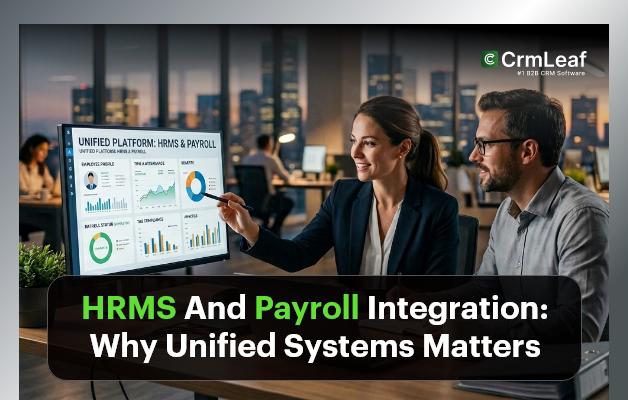
Therefore, a unified HRMS with integrated payroll breaks down these walls. Attendance data flows directly to payroll. Employee benefits update automatically. As a result, tax filings become accurate and compliance reporting takes minutes instead of days.
The Real Cost of Disconnected HR Systems
Let’s talk numbers. For instance, a typical mid-sized company with 200 employees spends significant resources managing separate systems. Here’s what goes wrong:
- Manual Data Entry: HR staff re-enter employee information into the payroll system. A single entry takes 10-15 minutes per employee.
- Payroll Errors: Disconnected systems cause 40% more payroll mistakes. These include wrong tax calculations, missed deductions, and incorrect overtime calculations.
- Compliance Risks: Separate systems make audit trails difficult. Companies face penalties when records don’t match government filings.
These operational issues also create an ongoing financial burden:
- Time Wastage: Finance teams spend 30-40 hours monthly reconciling HR and payroll data. This is time not spent on strategy.
- Employee Frustration: Payroll corrections take weeks. Employees see wrong deductions or missing benefits. Support tickets pile up.
Real example: A growing IT services firm with 150 remote developers used separate HR and payroll systems. When one developer relocated, HR updated their address, but payroll didn’t. Tax forms went to the wrong location. The correction took six weeks and cost the company in penalties and staff hours.
How HRMS and Payroll Integration Works
Simply put, integration means two systems talk to each other automatically. Here’s the integrated workflow:
- Employee Data: HR staff create an employee record once. This includes name, department, salary, benefits, and tax information.
- Real-Time Sync: Payroll receives this data instantly. No manual entry needed.
- Attendance to Payroll: Time tracking data flows automatically. Hourly workers’ hours become payroll input.
- Deductions and Benefits: Changes in health insurance or retirement contributions update across systems instantly.
- Payroll Processing: Finance teams run payroll with accurate, up-to-date data. No reconciliation needed.
Compliance Reports: Tax filings, labor reports, and compliance documents generate automatically and accurately.
Consequently, this seamless flow happens because integrated systems share a single database. Therefore, one source of truth eliminates confusion and errors.
Top Benefits of Unified HRMS and Payroll Systems
1. Eliminate Data Entry Errors
Manual data entry causes problems. In fact, studies show that spreadsheets and manual processes have a 3-5% error rate. When you enter employee data once, both HR and payroll use the same information. As a result, mistakes vanish and payroll accuracy jumps above 99%.
2. Save Significant Time
For example, the average finance team spends 40 hours monthly on payroll reconciliation. An integrated payroll automation system cuts this to under 5 hours. That’s 35 hours freed up for strategic work. For an agency with five finance staff members, that’s 175 hours monthly. Companies using unified HRMS save 30% on administrative time.
3. Improve Compliance and Reduce Risk
Labor laws change constantly. Tax regulations shift. Integrated systems maintain accurate records automatically. Audit trails show every change. Government filings include correct data the first time. Your company avoids costly penalties and stays prepared for audits.
4. Enhance Employee Experience
Employees want accuracy and speed. Paycheck corrections happen instantly in integrated systems. Self-service portals let employees check their pay stubs and tax documents anytime. They see benefits information that’s always current. Consequently, trust increases.
5. Enable Data-Driven Decision Making
Integrated systems generate real-time payroll dashboards instantly. You see labor costs per department. Track overtime trends. Analyze turnover by role. Advanced reporting features help you optimize staffing and budgets based on real data.
6. Scale Without Adding Complexity
As your team grows, when you hire 50 new employees, integrated systems handle it smoothly. In addition, onboarding workflows trigger automatically. Furthermore, tax information processes instantly. Payroll accuracy stays consistent whether you manage 50 or 5,000 employees.
Real-World Examples of HRMS Integration Success
Remote Team at a Tech Startup
A tech startup with 80 remote employees across five countries struggled with payroll. Each country had different tax rules. Using separate systems caused delays. However, after implementing HRMS software, everything changed. As a result, employee data synced instantly. Additionally, tax calculations happened automatically for each country. Payroll processed in one day instead of three. The team reduced errors by 90% and freed up 25 hours monthly.
Growing Marketing Agency
A marketing agency with 40 team members used spreadsheets and disconnected systems. When freelancers were hired, their data had to be entered twice. The finance manager spent eight hours weekly on payroll prep. After switching to an integrated team management platform, everything automated. Contractor onboarding takes 30 minutes. Payroll processing takes one hour. The team now handles double the employees without increasing headcount.
Manufacturing Firm with Shift Workers
A 200-person manufacturing firm employed shift workers with complex overtime rules. Time tracking data entered into payroll manually caused constant errors. Consequently, employees complained about incorrect pay. Additionally, the finance team spent 50 hours monthly reconciling. With unified payroll integration, attendance data flows directly to payroll. As a result, overtime calculations happen automatically. Consequently, payroll errors dropped to near zero. Finally, employee complaints about pay stopped.
Key Features to Look for in an Integrated HRMS
Not all HRMS platforms offer true integration. Here’s what matters:
- Real-Time Data Sync: Changes in HR update payroll instantly. There are no delays and no batch jobs.
- Automated Workflows: Onboarding, benefits enrollment, and payroll runs trigger automatically based on events.
- Multi-Currency and Tax Support: If you hire globally, the system must handle different tax rules and currencies.
- Compliance Features: Built-in compliance ensures you meet labor laws. Reports generate automatically for audits. Learn more about payroll compliance requirements.
- Attendance Integration: Time tracking connects to payroll without manual work.
- Employee Self-Service: Employee management tools let workers update information themselves. This reduces HR workload.
- Role-Based Access: Roles and permissions ensure sensitive payroll data stays secure.
Comprehensive Reporting: Reports and analytics give you insights into labor costs and staffing trends.
HRMS Integration Best Practices
Implementing an integrated system takes planning. Here are proven strategies:
Start with Data Cleanup
Before switching systems, audit your current data. Fix inconsistencies. Remove duplicates. Consequently, clean data ensures smooth integration. Although this takes time upfront, it prevents migration problems.
Define Clear Roles and Workflows
Who enters employee data? Who approves time off? Which team member processes payroll? Document these workflows before implementation. Recruiting, onboarding, and performance processes should be clear. Therefore, clear workflows reduce confusion and errors.
Train Your Team Thoroughly
In many cases, staff resistance causes implementation failures. Invest in training. Show HR team members how the system reduces their workload. Demonstrate to payroll staff how accuracy improves. Train team managers on their roles. As a result, well-trained teams adopt platforms quickly.
Test Before Going Live
Run parallel payroll cycles with the old and new systems. Verify accuracy. Address issues before your real payroll cycle depends on the new system. Therefore, testing prevents costly mistakes.
Monitor and Optimize
After launch, track metrics. How long does payroll take? How many errors occur? Are employees satisfied? Use this feedback to optimize workflows. Regular check-ins keep the system working at peak performance.
The Future of HRMS and Payroll Integration
Technology evolves rapidly. Here’s what’s coming:
- AI-Powered Insights: Machine learning will predict staffing needs and optimize labor costs automatically.
- Blockchain for Compliance: Immutable records will make audits easier and more trustworthy.
- Advanced Analytics: Predictive models will help you identify flight risks and succession plan better.
- Seamless Integrations: HRMS will connect with all your business tools through APIs. Benefits management,
- accounting software, and recruiting platforms will share data effortlessly.
- Enhanced Security: Zero-trust security models will protect sensitive payroll data from breaches.
The future belongs to companies that embrace integrated systems. Understanding SMB payroll challenges and how to solve them will help you stay ahead.
Getting Started with HRMS and Payroll Integration
Ready to streamline your HR and payroll operations? To begin, start by assessing your current challenges. Are you spending too much time on manual tasks? Do payroll errors affect employee satisfaction? Do compliance reports take forever?
Fortunately, an integrated HRMS system solves these problems. Try it free today and see the difference unified systems make. In fact, most platforms offer free trials. Therefore, use this time to test workflows, migrate sample data, and verify accuracy.
Explore CRMLeafs complete solution and discover how many companies streamline their operations. Sign up free today and experience the power of integrated HRMS and payroll systems.
Key Takeaways
- HRMS and payroll integration eliminates data silos and manual errors.
- Unified systems save 30% on administrative time spent on HR and payroll tasks.
- Integration improves compliance, reduces risk, and enhances employee experience.
- Real companies see dramatic improvements in accuracy, speed, and employee satisfaction.
- Look for systems with real-time sync, automated workflows, and comprehensive reporting.
- Proper implementation requires data cleanup, clear workflows, training, and testing.
Integrated HRMS platforms represent the future of HR technology.
Final Thoughts
HRMS and payroll integration isn’t just a technical upgrade—it’s a smarter way to run your business.
At CRMLeaf, we’re focused on helping businesses simplify operations, improve efficiency, and scale without friction. A unified system ensures your people, processes, and payroll stay perfectly in sync.
Frequently Asked Questions
1. What exactly is HRMS?
HRMS (Human Resource Management System) is software that centralizes employee data and manages HR processes. It handles recruitment, onboarding, employee records, performance management, benefits, and compliance. When integrated with payroll, therefore, it creates a unified system for all HR operations.
2. How does HRMS integration reduce payroll errors?
Integration eliminates manual data entry. Employee information is entered once in the HRMS. Payroll automatically uses this data. Since there’s no re-entry, consequently, transcription errors vanish. Attendance data flows directly from time tracking systems, ensuring accurate hours. As a result, this dramatically improves payroll accuracy.
3. What’s the average time saved with integrated HRMS and payroll?
Most companies save 30-40 hours monthly. This comes from eliminating manual data entry, reducing reconciliation time, and automating routine tasks. Although the exact time saved depends on company size and current processes, the savings are substantial in all cases.
4. Is HRMS integration expensive?
Cloud-based HRMS platforms cost $3-10 per employee monthly. This typically includes payroll integration. For a 100-person company, that’s $300-1,000 monthly. The time saved and errors prevented quickly justify this cost. Start your free trial to see if it’s right for your company.
5. Can I integrate HRMS with my existing payroll system?
Many modern HRMS platforms integrate with popular payroll software through APIs. However, true integration where both systems share a database is more reliable. Some companies replace both systems simultaneously with an all-in-one solution that handles HR and payroll together.
6. How long does HRMS implementation take?
Implementation typically takes 4-12 weeks depending on company size and complexity. Small companies with clean data might go live in 4 weeks. Larger organizations with messy data or complex workflows take 8-12 weeks. The process includes data migration, workflow design, training, and parallel testing.
7. What compliance features should HRMS include?
Look for systems that track labor law changes, generate compliant employee documents, calculate taxes correctly, and maintain audit trails. The system should handle different jurisdictions if you have employees in multiple states or countries. Therefore, compliance features prevent costly penalties.
8. How does HRMS improve employee experience?
Integrated systems enable self-service portals where employees view pay stubs, update personal information, and access benefits information anytime. Payroll is accurate and timely. Employees can track their attendance and leave balances. As a result, this reduces HR support tickets and improves satisfaction.
9. What’s the difference between HRMS and a payroll service?
HRMS handles all aspects of employee management. Payroll services focus only on calculating and processing paychecks. However, some payroll companies offer limited HR features, but true HRMS covers recruitment, onboarding, performance management, compliance, and benefits administration alongside payroll.
10. Should small companies invest in integrated HRMS?
Absolutely. Even small companies with 10-20 employees benefit from HRMS integration. Specifically, it eliminates manual work, reduces errors, and helps you stay compliant as you grow. Moreover, cloud-based solutions are affordable and scalable. In fact, many companies start with free or low-cost plans and upgrade as they grow. Start your free trial to experience the benefits.