

⚡ TL;DR
Short on time? Here’s the quick version of customer service management software and why it matters in 2026:
- Best way to centralize support: Manage tickets, customer conversations, SLAs, and workflows from a single platform.
- Key features to look for: Ticket management, omnichannel support, AI routing, customer portals, knowledge bases, and reporting.
- Biggest business benefits: Faster response times, higher customer satisfaction, improved agent productivity, and lower customer churn.
- Why AI matters: AI automates ticket classification, routing, responses, and analytics to help support teams scale efficiently.
- Why CRMLeaf stands out: Combines customer support, CRM, projects, billing, HRMS, and automation in one unified platform.
Bottom line: If your team is struggling with shared inboxes, missed tickets, slow response times, or disconnected tools, customer service management software can help you deliver faster, more personalized support. An integrated platform like CRMLeaf enables businesses to streamline operations, improve customer experiences, and scale support without increasing complexity.
Customer expectations have never been higher. Buyers now compare every support experience against the fastest, most personalized brands they interact with, not just your direct competitors. As a result, customer service management software has shifted from a nice-to-have tool into core business infrastructure for growing companies in 2026.
At its simplest, customer service management software is a centralized platform that helps teams capture, organize, prioritize, and resolve customer requests across every channel. Instead of juggling shared inboxes, spreadsheets, and chat tools that do not talk to each other, your team works from a single source of truth that tracks each conversation from first contact to final resolution.
Why does this matter so much now? Because customer experience has become a measurable revenue driver. Studies consistently show that customers will pay more for better service, and that a single poor experience is often enough to send them to a competitor. According to widely cited industry research, the vast majority of consumers say customer experience is as important as the product itself, and most will abandon a brand after only a few negative interactions.
Meanwhile, disconnected support tools quietly drain productivity. Agents waste time switching between apps, customer history disappears between channels, and managers struggle to report on what actually happened. That is exactly why businesses are replacing fragmented stacks with unified systems. This complete guide explains what the software does, the features that matter, how it compares to traditional help desks, and how a unified platform like CRMLeaf brings support, CRM, and operations together.
What Is Customer Service Management Software?
Customer service management software is a customer service management system that centralizes every customer interaction, automates routine support work, and gives teams the tools to resolve issues quickly and consistently. It combines ticketing, communication channels, automation, and analytics into one connected workflow.
Think of it as the operational backbone of your support team. When a customer emails, fills out a web form, sends a chat message, or replies on social media, the platform converts that request into a trackable ticket. From there, the system routes the ticket to the right person, applies service-level agreement (SLA) timers, surfaces relevant customer history, and logs every action for reporting.
The category overlaps with several familiar terms. You will hear it called customer support management software, a customer support platform, help desk software, or a customer service CRM. While the labels differ, the goal is the same: deliver fast, organized, and personalized support at scale without letting requests slip through the cracks.
Modern solutions go further than simple ticketing. They add omnichannel inboxes, AI-powered ticket routing, self-service customer portals, knowledge bases, and customer satisfaction (CSAT) tracking. The best platforms connect directly to your CRM so support agents see the full relationship, including past purchases, open deals, and previous conversations, the moment a ticket arrives.
Crucially, the value of these systems compounds over time. Every resolved ticket, logged note, and customer interaction becomes part of a searchable history that makes the next interaction smarter. New agents ramp faster because context is already documented, managers spot recurring problems before they spread, and the entire organization builds institutional knowledge instead of losing it whenever someone changes inbox folders or leaves the company.
Why Customer Service Is Becoming a Competitive Advantage
For years, customer service was treated as a cost center, a department to be made cheaper rather than better. That thinking is outdated. In 2026, service quality is one of the clearest ways for growing businesses to differentiate, especially in crowded markets where products look increasingly similar.
Consider the economics. Acquiring a new customer typically costs five to seven times more than retaining an existing one, and even small improvements in retention can produce outsized gains in profitability. Great service protects the revenue you already earned, increases lifetime value, and turns satisfied customers into referral engines.
Speed is a major part of the equation. Research from customer experience leaders shows that fast response times are among the top drivers of satisfaction, yet many teams still take hours, or even days, to reply. A capable customer support platform closes that gap with automation, smart routing, and templated responses, so customers feel heard within minutes rather than days.
There is also a reputational dimension. In an era of public reviews and social media, every interaction is potentially visible. Consistently excellent service builds trust, strengthens your brand, and creates a defensible moat that competitors cannot easily copy. Simply put, businesses that treat service as a strategic asset grow faster and churn less.
Perhaps most importantly, service has become a source of growth, not just retention. Happy customers buy more, upgrade sooner, and refer others. Support conversations reveal upsell opportunities, product feedback, and early warning signs of churn that sales and product teams cannot see anywhere else. When customer service runs on a connected platform, those insights flow naturally to the people who can act on them, turning a traditional cost center into a genuine engine for revenue and innovation.
Common Customer Support Challenges Businesses Face
Before exploring features, it helps to name the problems that customer service management software is designed to solve. Most growing teams recognize several of the following pain points immediately. Each one may seem minor in isolation, but together they compound into slower service, frustrated agents, and lost customers.
Slow Response Times
When requests arrive across scattered channels, replies are delayed and customers grow frustrated. Without automation and prioritization, urgent issues wait in line behind routine questions.
Missed Tickets
Shared inboxes make it easy for messages to be overlooked, double-handled, or forgotten entirely. A request that nobody owns is a request that nobody answers, and those silent failures quietly erode trust.
Lack of Customer History
Agents who cannot see previous conversations or purchase history ask customers to repeat themselves. This wastes time, signals disorganization, and makes personalization impossible.
Team Collaboration Issues
Complex issues often need input from multiple people. Without internal notes, assignment rules, and visibility, collaboration breaks down and accountability disappears.
Poor Reporting
If you cannot measure response times, resolution rates, and satisfaction, you cannot improve them. Manual reporting is slow, error-prone, and usually outdated by the time it reaches a decision-maker.
SLA Violations
Promising a response time and then missing it damages credibility, especially for B2B and IT service providers bound by contractual commitments. Without automated SLA tracking, breaches are discovered too late to fix.
Key Features Every Customer Service Management Software Should Have
Not every platform is created equal. The strongest customer service management systems combine the following capabilities into one seamless experience. Use this list as an evaluation checklist when comparing vendors.
Ticket Management
Ticket management is the foundation. Every request becomes a structured ticket with an owner, status, priority, and history. Good ticket management software ensures nothing is lost, every issue has clear accountability, and progress is visible to the whole team.
Omnichannel Support
Customers reach out through email, live chat, phone, web forms, and social media. Omnichannel customer support unifies all of these channels into a single inbox so agents see the full conversation in one place, regardless of where it started or how it continues.
SLA Tracking
Service-level agreements set expectations for response and resolution times. Automated SLA tracking applies timers, escalates at-risk tickets, and alerts managers before a breach occurs, helping teams honor their commitments consistently.
AI-Based Ticket Routing
AI-based routing reads the content and context of each request and assigns it to the best-suited agent or team automatically. This removes manual triage, reduces first-response time, and ensures specialized issues reach specialists immediately.
Customer Portal
A self-service customer portal lets customers submit tickets, track status, and find answers on their own schedule. It reduces inbound volume while giving customers transparency and control over their requests.
Knowledge Base
A searchable knowledge base houses articles, FAQs, and how-to guides. It empowers customers to solve common problems themselves and gives agents a consistent, reusable source of accurate answers.
Time Tracking
Time tracking records how long agents spend on tickets and projects. For consulting firms, IT service providers, and BPO companies, this data is essential for billing, capacity planning, and measuring efficiency.
Reporting & Analytics
Robust reporting turns raw activity into insight. Dashboards reveal response times, resolution rates, agent workloads, channel performance, and satisfaction trends, so managers can make decisions based on evidence rather than guesswork.
Customer Satisfaction Surveys
Built-in CSAT and feedback surveys capture sentiment immediately after each interaction. As a result, this closes the loop, highlights coaching opportunities, and provides a clear, ongoing measure of service quality.
Workflow Automation
Workflow automation handles repetitive tasks such as assigning tickets, sending acknowledgments, escalating priorities, and triggering follow-ups. Automation frees agents to focus on the conversations that genuinely need a human touch.
Project Milestone Tracking
Many support issues evolve into larger pieces of work, such as onboarding, implementations, or multi-step fixes that span days or weeks. Project milestone tracking lets teams break that work into defined stages with owners and due dates, then monitor progress against each milestone. This keeps complex requests moving, gives customers clear visibility into where things stand, and connects day-to-day support to longer-term delivery commitments.
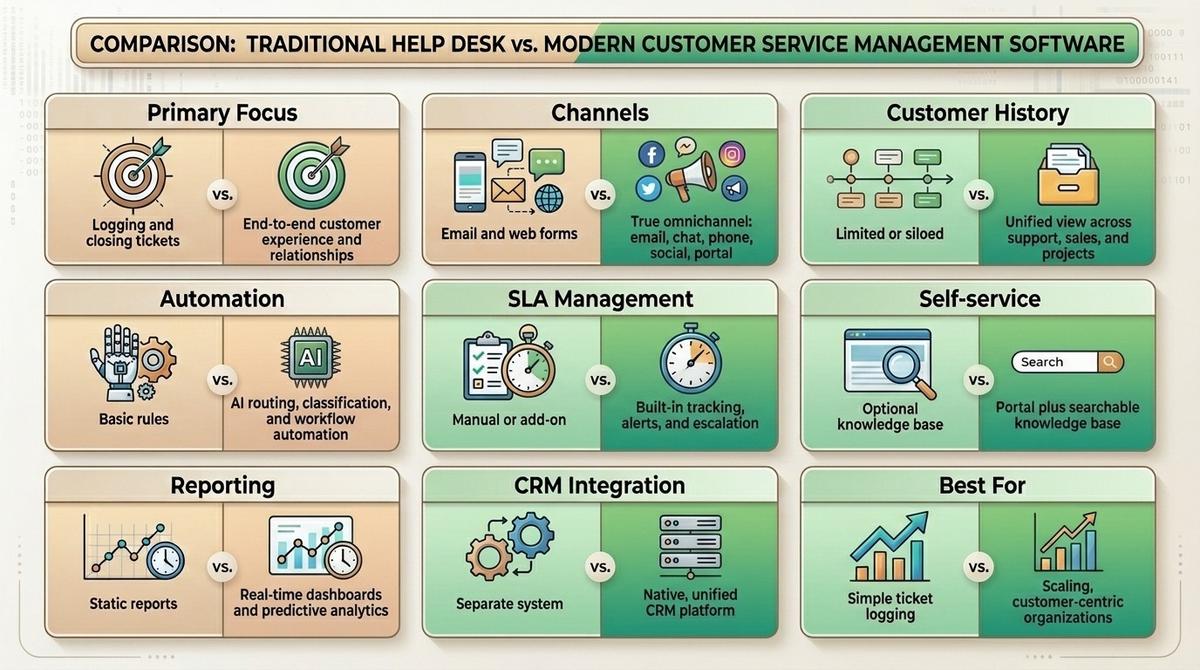
Customer Service Management Software vs Traditional Help Desk
Traditional help desk tools were built mainly to log and close tickets. However, modern customer service management software does that and far more, connecting support to the broader customer relationship. As a result, businesses gain greater visibility, automation, and customer insights. The table below highlights the practical differences.
Benefits of Using Customer Service Management Software
Investing in the right platform delivers returns across the entire organization, not just within the support team. The most significant benefits include the following.
- Faster resolution time. Automation, smart routing, and ready access to context help agents resolve issues quickly, often on first contact.
- Higher customer satisfaction. Quick, personalized, and consistent responses raise CSAT and Net Promoter Scores, strengthening loyalty.
- Better agent productivity. By removing manual triage and repetitive tasks, agents handle more conversations with less stress and fewer errors.
- Reduced customer churn. Resolving problems reliably keeps customers from leaving, protecting recurring revenue and lifetime value.
- Increased operational efficiency. Centralized workflows eliminate duplicated effort and reduce the cost of every resolved ticket.
- Better reporting visibility. Real-time dashboards give leaders the data they need to forecast staffing, spot bottlenecks, and improve service.
- Improved revenue retention. Because service quality directly affects renewals and expansion, strong support translates into measurable revenue protection.
How AI Is Transforming Customer Service Management
Artificial intelligence has moved from buzzword to backbone. Today, in 2026, AI is woven through every stage of the support workflow, helping teams do more with the resources they already have. As a result, organizations can improve efficiency, reduce response times, and deliver better customer experiences. Here is where it makes the biggest impact.
- AI ticket classification. AI reads incoming requests, understands intent, and tags each ticket by topic, urgency, and sentiment, eliminating manual sorting and surfacing critical issues instantly.
- AI routing. Intelligent routing assigns each ticket to the most qualified agent or team based on skills, workload, and history, cutting wait times and improving first-contact resolution.
- Chatbots and virtual agents. AI chatbots resolve common questions around the clock, collect details before handoff, and deflect routine volume so human agents focus on complex work.
- Predictive analytics. By analyzing patterns, AI forecasts ticket volume, flags accounts at risk of churn, and identifies recurring issues before they escalate.
- Automated responses. AI drafts suggested replies and knowledge-base answers, helping agents respond faster while keeping tone and accuracy consistent.
Importantly, the goal is not to replace people but to augment them. AI handles volume and repetition, while humans bring empathy and judgment to the conversations that matter most. Teams that pair the two consistently outperform those relying on either alone.
The financial case is compelling as well. By deflecting routine questions to chatbots and self-service, automating triage, and drafting replies, AI lowers the cost per resolved ticket while raising throughput. Many organizations report that AI assistance meaningfully reduces average handling time and lets existing teams absorb growth without proportional headcount increases. The result is a support operation that scales with demand instead of buckling under it.
Industries That Benefit Most From Customer Service Management Software
While almost every business benefits from organized support, certain industries see especially strong returns because of their volume, complexity, or contractual obligations.
- SaaS companies. High ticket volumes, recurring revenue, and a direct link between support quality and retention make unified service essential.
- IT service providers. SLA-driven contracts demand precise tracking, escalation, and reporting that manual tools cannot reliably deliver.
- Professional and consulting services. Time tracking, billing, and client communication all benefit from a single connected platform.
- BPO companies. Outsourced teams manage support for multiple clients and need automation, routing, and detailed analytics to stay efficient and accountable.
- Telecom. Massive request volumes and strict service expectations require omnichannel support and robust automation.
- Manufacturing. Warranty claims, dealer support, and field coordination are easier to manage from one organized system.
- Healthcare. Patient inquiries, scheduling, and follow-ups demand secure, reliable, and well-documented communication.
- Field service. Coordinating technicians, tracking jobs, and updating customers in real time depend on connected workflows and mobile access.
How CRMLeaf Simplifies Customer Service Management
Many tools handle one piece of the puzzle. CRMLeaf takes a different approach by bringing customer support together with the rest of your business in a single, unified platform. Instead of stitching together separate apps, your team works from one connected system where every interaction, contact, and project lives side by side.
Within its customer service management module, CRMLeaf covers the full support lifecycle:
- Omnichannel support that consolidates email, chat, web forms, and more into one shared inbox.
- Ticket management with clear ownership, statuses, and priorities so nothing slips through.
- AI classification that tags and organizes incoming requests automatically.
- SLA monitoring with timers, alerts, and escalation to keep commitments on track.
- A customer portal where clients submit and track requests independently.
- Time tracking that records effort against tickets and projects for accurate billing.
- Invoicing so billable support work flows straight into payment without re-keying data.
- A knowledge base that powers self-service and consistent agent answers.
- CSAT tracking to measure satisfaction after every resolved ticket.
- A reporting dashboard offering real-time visibility into performance and trends.
- Workflow automation that handles routine tasks and frees agents for meaningful work.
- Project milestone tracking that breaks larger requests into clear stages so complex work stays on schedule.
- Document management that keeps contracts, attachments, and customer files organized alongside every ticket and account.
- Quotation that lets teams create and send quotes directly from the platform when support uncovers new work.
- Billable expenses that capture costs incurred while resolving issues and pass them straight through to invoicing.
What truly sets CRMLeaf apart is how it connects customer support to the wider organization. Because support lives inside the same platform as your CRM, projects, HRMS, and billing, the boundaries between departments disappear.
When a support ticket arrives, agents instantly see the customer’s complete relationship: open deals, past purchases, active projects, and previous conversations. A support issue can flow into a project task, time logged on that task can flow into an invoice, and the whole journey is visible to sales, operations, and finance alike. This unified model removes the data silos that slow most teams down and gives every department a single, accurate view of the customer.
For growing businesses, this consolidation also lowers cost and complexity. Instead of paying for, integrating, and maintaining a separate help desk, CRM, project tool, HR system, and billing platform, you run everything from one place with one login and one set of reports. Fewer integrations mean fewer points of failure, faster onboarding for new staff, and a clearer picture of how support effort translates into revenue. As your needs evolve, the platform grows with you, so the system you start with is the same one that supports you at scale.
Signs Your Business Has Outgrown Email-Based Support
Email is a perfectly reasonable starting point, but it breaks down as you grow. Watch for these warning signs that it is time to upgrade to dedicated customer service management software.
- Requests are slipping through the cracks or getting answered twice.
- You cannot tell who is responsible for which conversation.
- Customers complain about slow or inconsistent responses.
- You have no reliable way to measure response or resolution times.
- Agents constantly ask customers to repeat information.
- SLA commitments are missed because nothing tracks them automatically.
- Reporting requires manual spreadsheet work that is always out of date.
- Volume is rising faster than your inbox can handle.
If several of these sound familiar, your support process is already costing you customers and revenue. Moving to a structured platform is no longer optional; it is a growth requirement.
Customer Service Management Software Implementation Checklist
A smooth rollout is just as important as choosing the right tool. Follow these steps to implement customer service management software successfully and see results quickly.
- Define your goals and metrics. Decide what success looks like, such as faster response times, higher CSAT, or fewer missed tickets, and set baseline numbers to measure against.
- Map your current workflows. Document how requests arrive today, who handles them, and where the bottlenecks are, so you can improve rather than simply digitize a broken process.
- Choose the right platform. Evaluate vendors against the feature checklist above, prioritizing omnichannel support, automation, SLA tracking, and CRM integration.
- Consolidate your channels. Connect email, chat, web forms, and social accounts so every request flows into one unified inbox.
- Configure automation and SLAs. Set up routing rules, priorities, escalation paths, and SLA timers that match your service commitments.
- Build your knowledge base. Create articles for your most common questions to power self-service and speed up agent responses.
- Migrate data and integrate systems. Import existing contacts and history, and connect your CRM, billing, and project tools for a single source of truth.
- Train your team. Give agents hands-on training and clear playbooks so adoption is fast and confident.
- Launch in phases. Start with one channel or team, gather feedback, refine, and then expand across the organization.
- Measure, review, and optimize. Use dashboards to track your goals, review performance regularly, and continuously improve workflows.
Future Trends in Customer Service Management for 2026 and Beyond
Customer service is evolving quickly, and the platforms that lead in 2026 are already pointing toward the next wave of change. Keep these trends on your radar as you plan for the future.
- AI agents. Autonomous AI agents will independently resolve a growing share of routine requests end-to-end, escalating only when human judgment is required.
- Hyper-personalization. Drawing on unified customer data, platforms will tailor every interaction to the individual’s history, preferences, and value to the business.
- Predictive support. Instead of waiting for problems, systems will anticipate issues and reach out proactively before customers even notice.
- Advanced self-service portals. Smarter portals and knowledge bases will let customers resolve more on their own, with AI guiding them to the right answer instantly.
- Unified customer experience. The line between support, sales, and success will continue to blur as businesses adopt single platforms that deliver one seamless journey.
The common thread is integration. The future belongs to connected systems that unify data and intelligence, rather than collections of disconnected tools. Businesses that adopt this model now will be best positioned to compete on experience for years to come.
Conclusion
Customer service has become a defining competitive advantage, and the software you choose to manage it directly shapes how fast you grow. Therefore, the right platform helps you respond faster, resolve issues consistently, satisfy customers, and protect the revenue you have already earned.
Throughout this guide, a few takeaways stand out. Disconnected tools quietly cost you time, customers, and revenue.
The strongest customer service management systems unify channels, automate routine work, track SLAs, and connect support to the wider customer relationship. Additionally, AI is now central to scaling service efficiently, and the future clearly belongs to integrated, intelligent platforms.
If you are ready to move beyond scattered inboxes and disconnected apps, then it is worth seeing how a unified approach works in practice. Furthermore, explore CRMLeaf’s customer service management software to discover how support, CRM, projects, HRMS, and billing come together in one place. Ultimately, the businesses that win in 2026 will be the ones that make every customer interaction fast, personal, and effortless, and the right platform is what makes that possible at scale.