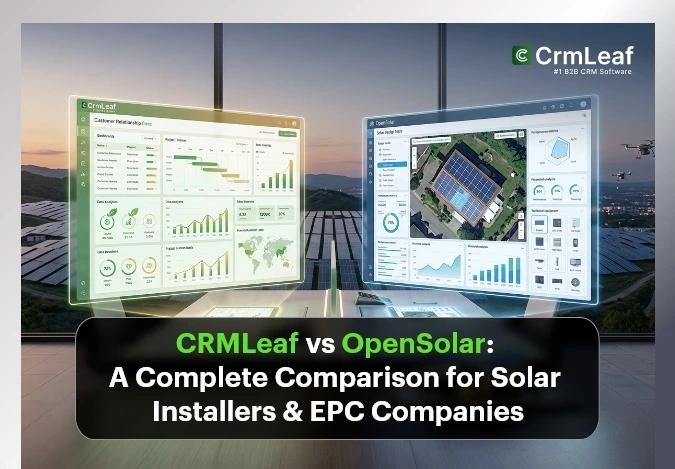


A solar installation business runs through the same fourteen stages whether it closes ten deals a year or a thousand. What differs company to company isn’t the sequence – it’s whether each stage flows automatically into the next, or requires someone to manually carry information from one tool to another. This guide walks the full sequence, the way it works when nothing has to be re-typed.
1. Lead capture from multiple sources
Leads arrive from a mix of channels – paid ads, referrals, a website form, door-knocking campaigns. Each source should create a Lead record automatically rather than landing in a shared inbox someone has to manually enter.
2. Deal creation and nurturing
A qualified Lead becomes a Deal, moving through defined pipeline stages. This is where most CRMs, generic or solar-specific, are on equal footing – the differentiation starts at the next stage.
3. Site inspection and status
A technician visits the site and documents roof condition, shading, and electrical capacity. This inspection status should attach directly to the Deal record, not live in a separate app or on paper.
of deals stall specifically in the window between inspection and proposal when inspection data isn’t linked directly to the deal
4. Proposal generation from inspection results
The proposal should be built directly from the inspection findings – panel count, system size, estimated production – not manually reconstructed in a separate document editor.
5. Deal won – the Client hierarchy begins
Once the proposal is approved, the Deal becomes a Client – the top of the post-sale hierarchy. Everything from this point forward organizes underneath the Client record.
“The moment a deal is won, the sales side of our business ends and the delivery side begins. If those two sides don’t share data, the client feels the seam immediately.”
Founder, residential and commercial solar installer
6. Project, Milestones, and Tasks
Under the Client, a Project is created, broken into Milestones (permitting, material delivery, installation, inspection, activation), and further into Tasks assigned to specific team members with due dates.
7. Bill of Quantities and material requisition
At the task level, a BOQ specifies exactly what materials and labor the task requires. Creating the BOQ should automatically generate a material requisition sent to the warehouse or store manager – see our full breakdown in BOQ vs BOM in Solar EPC Projects.
8. Task execution, dependencies, and progress
Tasks can depend on one another – installation can’t start before material delivery, for instance – and overall project progress should roll up automatically from task completion, visible without a status meeting.
9. Invoicing: BOQ becomes BOM
Once a milestone or the full project completes, BOQ items convert into a Bill of Materials on the invoice, alongside any additional service line items, and the invoice goes to the client.
10. Payment and finance integration
With an accounting integration such as QuickBooks, payment status updates instantly, and the client can often pay directly from the invoice itself rather than through a separate payment request.
⚠ Common gap: When invoicing isn’t connected to the BOQ, additional materials used on-site after the original estimate frequently never make it onto the final bill – a direct, recurring revenue leak.
11. Inventory and warehouse management
Products carry both a selling cost and a purchase cost, tracked across multiple warehouses, with a transfer log between locations. Live inventory should show opening stock, committed stock, stock available for sale, and stock already allocated to open purchase orders.
12. Vendor management and procurement
Vendor records, purchase orders, and vendor payments close the procurement loop – stock decrements automatically as materials move out to a BOQ or invoice, without a manual count.
💡 Key takeaway: Inventory that doesn’t decrement automatically when material is consumed on a job is inventory no one actually trusts – and untrusted inventory data is what drives expensive “just in case” overordering.
13. Support tickets
Post-installation issues – performance questions, warranty claims – should route as Tickets linked to both the Client and the Project, assignable to specific agents with visible progress tracking.
14. Field workforce: attendance, geo-tracking, and billable time
Field technicians clock in and out from mobile, with geo-tracking active between check-in and check-out. Resource-wise hourly rates let logged time be marked billable, feeding directly into both project cost tracking and the client invoice.
None of these fourteen stages is optional for a solar business – they happen regardless of what software is or isn’t in place. The only real choice is whether the data from one stage flows automatically into the next, or whether someone has to carry it there by hand, every single time.
Conclusion
Every solar installation company, regardless of size, follows the same operational journey. Leads are captured, inspections are performed, proposals are created, projects are delivered, invoices are issued, and customers require ongoing support long after the installation is complete.
What separates a company installing ten systems a year from one delivering thousands is not the number of stages in the process – it is the quality of the handoffs between those stages.
When teams rely on disconnected systems, information gets lost. Materials go unbilled. Projects stall waiting for updates. Inventory numbers become unreliable. Finance teams spend hours reconciling invoices and payments. Customers experience delays and communication gaps that damage trust and referrals.
When the workflow is connected, the opposite happens.
Lead information flows directly into project delivery. Site inspection data generates accurate proposals. BOQs automatically trigger procurement and warehouse actions. Completed work becomes invoices without manual re-entry. Payments synchronize with accounting systems. Support teams can instantly access the complete project history when customers need assistance.
The result is faster project delivery, better cash flow, fewer operational errors, improved customer experience, and a business that can scale without increasing administrative overhead at the same pace.
The fourteen stages outlined in this guide are not optional steps – they are the operational backbone of every solar installation business.
The real question is simple:
Will your team spend its time moving information between systems, or will your systems move information for your team?