
⚡ TL;DR: Solar BOQ Accuracy
- Solar BOQ = project cost foundation: A Bill of Quantities lists every solar material, component, and labour item required for installation – forming the basis for pricing, procurement, inventory, and profit planning.
- BOQ errors directly reduce profit: Incorrect quantities, missing BOS items, cable underestimation, and outdated pricing lead to cost overruns, emergency procurement, delays, and margin erosion.
- 7 categories must always be included: Panels, inverters, mounting structure, DC components, AC components, earthing & safety items, plus labour and professional services.
- Cable calculations must be measured – not estimated: DC and AC cable runs should follow actual routing paths with proper wastage allowances. Cable shortages are the most common on-site installation emergency.
- System presets and automation save massive time: Software-generated BOQs improve accuracy, consistency, and speed – reducing preparation time from hours to minutes while eliminating repetitive manual errors.
What is a solar BOQ, why accuracy matters, and how solar BOQ software uses it
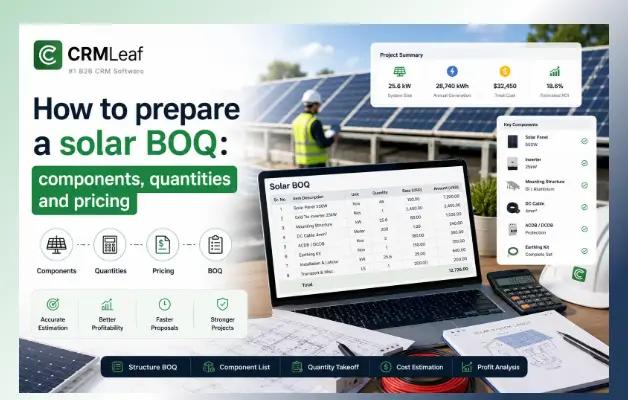
A Bill of Quantities – commonly abbreviated BOQ – is the document that solar BOQ software generates automatically from site survey data: a structured, itemised list of every material, piece of equipment and unit of labour required to complete a solar installation, with quantities and unit prices for each line item. It is the financial and technical backbone of every solar project: the document from which the commercial proposal is derived, the procurement plan is generated, the inventory is reserved and the final project cost is reconciled.
An accurate BOQ – produced with the help of solar technical assessment software – prevents four of the most damaging problems in solar project execution: cost overruns (because actual material costs exceed the BOQ estimate), material shortages on site (because the BOQ under-quantified certain items), emergency procurement (because the shortage was not identified until installation day) and margin erosion (because one or more of the above, or a combination, absorbed project margin that the company believed it had captured at the proposal stage).
An inaccurate BOQ creates all four problems simultaneously. And because the BOQ is prepared before the contract is signed, the consequences of its errors are locked in before the project begins.
The relationship between BOQ accuracy and project profitability is direct. A solar project with a 15% profit margin at the BOQ stage has no room for a 10% material overrun. A 10% cable overrun on a project where cables represent 8% of the total material cost reduces the project margin by approximately 0.8 percentage points – not a disaster in isolation, but catastrophic when combined with other small errors across the same project. In practice, BOQ errors tend to cluster: a project that under-quantifies cables also tends to under-quantify conduit, under-quantify connectors and miss a BOS component. The aggregate effect on the margin is significant.
The 7 component categories every solar BOQ must include
A complete solar BOQ covers seven distinct component categories. A BOQ that is missing any of these categories is incomplete and will produce surprise costs during procurement or installation. Each category is discussed below with the specific items that must be included and the calculation method for each.
Category 1: Solar panels
The panel section of the BOQ specifies the panel manufacturer, model, wattage rating and quantity. Panel specification is not a “to be confirmed” item – the exact model must be specified in the BOQ because panel substitution creates downstream risks. A panel of different dimensions may not fit the planned mounting configuration. A panel with different electrical characteristics (Voc, Isc, temperature coefficients) may affect inverter MPPT compatibility and string current matching. A panel from a different manufacturer may not be on the utility’s approved list, blocking grid connection approval.
Panel technology selection considerations:
- Monocrystalline PERC: Standard choice for most residential and commercial applications. Higher efficiency than multicrystalline, good temperature coefficient, well-supported supply chain.
- Bifacial: Appropriate for ground mount systems with high ground albedo (light-coloured surfaces, snow, white gravel) or rooftop systems with a reflective membrane. Bifacial gain varies significantly with installation conditions – only specify bifacial where the site conditions justify the premium.
- Glass-glass modules: Higher durability and better performance in humid, coastal or industrial environments. Specify for challenging climatic conditions or where warranty longevity is a priority.
- Building-integrated PV (BIPV): Used where aesthetic integration is required (heritage buildings, architectural glass facades). Significantly higher cost per kWp and specialist installation requirements.
Category 2: Inverters
Inverter specification requires more engineering input than any other BOQ line item. The inverter must be correctly sized to the DC array capacity, compatible with the string configuration that results from the panel layout, and compliant with local grid connection standards (G98/G99 in the UK, AS4777 in Australia, VDE-AR-N 4105 in Germany, IEEE 1547 in the USA).
Key specification parameters:
- Rated AC output power: Must not exceed the permitted connection capacity at the connection point. For residential systems, this is typically limited by the household’s single or three-phase supply capacity.
- DC/AC ratio (clipping ratio): For most residential applications, a DC/AC ratio of 1.1–1.25 is appropriate – the DC array is slightly oversized relative to the inverter AC rating to maximise production during low-irradiance periods while accepting minor clipping at peak irradiance. Higher ratios require careful analysis of the production profile and local irradiance patterns.
- Number of MPPT trackers: Each string requires a dedicated MPPT input, or multiple strings of identical length and orientation can be combined on a single MPPT input. The number of MPPT trackers determines how many different roof orientations or shading scenarios can be handled independently.
- Topology: String inverters (centralised AC conversion), microinverters (panel-level AC conversion), DC optimisers with string inverter (panel-level DC optimisation, central AC conversion), or hybrid inverters (built-in battery interface). String inverters are the cost-effective default for most applications; microinverters and DC optimisers are justified by complex shading, multiple orientations or monitoring requirements.
Category 3: Mounting structure
Mounting structure specification is entirely roof-type-specific. The BOQ must specify the correct mounting system for the actual roof construction, not a generic “mounting structure” line item. Using the wrong mounting system – hooks designed for one tile profile installed on an incompatible profile – is a common cause of roof damage claims and installation rework.
Roof-type-specific considerations:
- Concrete tile: Tile hooks installed through tiles at rafter positions. Hook selection must match the specific tile profile (flat, S-profile, double Roman, pantile etc.) – use the tile profile measurement and the manufacturer’s hook compatibility guide.
- Clay/terracotta tile: Similar to concrete tile but with greater fragility. Reduced-footprint hooks to minimise tile contact. Consider rubber seal compatibility with terracotta glazing.
Metal standing seam: Clamp-on attachment to seam profiles – no roof penetration required. Seam width and profile must be measured precisely. - Corrugated metal: Through-fixings at ridge positions of the corrugation with appropriate flashing. Corrosion compatibility between fixing material and roof material is critical.
- Flat roof: Ballasted system (concrete blocks or proprietary ballast on membrane) or mechanically fixed into structural deck. Ballast weight must be within the structural load capacity of the roof. Wind uplift calculation required for all flat roof systems.
- Ground mount: Driven piles, screw piles or concrete pads depending on soil conditions. Structure must be engineered for local wind and snow load conditions.
Mounting structure BOQ quantities must be calculated from the panel layout drawing, not estimated. The number of rails is a function of the panel configuration; the number of mounting feet is a function of the rail length and spacing; the number of mid clamps, end clamps and tile hooks follows from the panel and rail count. Generic “per kWp” estimates for mounting structure are inaccurate and should not be used.
Category 4: DC electrical components
DC components cover the wiring between the solar panels and the inverter’s DC input terminals. The BOQ must include:
- DC cable: PV-rated cable (to IEC 62930 or equivalent local standard), typically 4mm² for string runs up to 30 metres and 6mm² for longer runs where voltage drop must be minimised. Quantity is calculated from the measured routing length with a 15–20% wastage and termination allowance. Cable under-ordering is one of the most common on-site procurement emergencies in solar installation.
- MC4 connectors (or equivalent): Required in pairs (one positive, one negative) at each panel junction. Total pairs = number of panels × 2 (one per cable end at each panel). Note: connectors from different manufacturers should not be intermated even when they appear mechanically compatible – always specify a single connector brand consistent with the panel connector type.
- DC isolator switch: Required at the inverter DC input point (and sometimes at the array) per local wiring regulations. Specify volt and amp rating consistent with the maximum DC system voltage and short circuit current.
- DC surge protection device: Type 2 SPD appropriate for the system Voc. Required by some national wiring regulations and strongly recommended for all systems in areas with elevated lightning risk.
- String combiner box: Required for systems with multiple strings that need to be combined before the inverter DC input. Size the combiner box for the number of strings plus a 20% spare capacity for future expansion if the installation context suggests expansion is likely.
- DC fusing: Required per string in combiner box installations. Fuse sizing must be consistent with the cable ampacity and the panel short-circuit current.
Category 5: AC electrical components
AC components cover the connection between the inverter’s AC output and the building’s electrical distribution system or grid connection point. The BOQ must include:
- AC cable: Sized for the inverter-rated AC current and the cable run length, with a voltage drop calculation confirming drop is below the applicable code limit (typically 1% for generation circuits). Longer runs require larger cross-section – the cable cost difference between a correct and incorrect AC cable specification can be significant for longer runs.
- AC isolator switch: Required at the inverter AC output and at the consumer unit/distribution board, per local wiring regulations.
- Residual current device (RCD): Required in most jurisdictions for circuits containing solar generation equipment. Specify the appropriate RCD type (Type A or Type B, depending on inverter topology) – incorrect RCD type selection is a common cause of failed electrical inspections.
- AC surge protection device: Recommended at the consumer unit to protect against grid-borne transients.
- Generation meter: Required for feed-in tariff, net metering or export monitoring. Specify the meter type required by the local utility – in some markets, the utility installs the meter; in others, the installer must supply a pre-approved meter model.
- Export limiting device: Required by some utilities to prevent net export above a specified threshold. Specify if required by the local utility.
Category 6: Earthing, protection and safety
This category is the most frequently omitted from solar BOQs – particularly in BOQs prepared by sales staff rather than qualified engineers. Earthing and bonding is required by electrical codes in every major solar market, and its omission from the BOQ creates rework costs that are completely avoidable.
- Earthing electrode: Driven earth rod or earth plate, with appropriate soil resistance testing where required. The resistance-to-earth value must meet the local electrical code requirement.
- Earthing conductors: Main protective earthing conductor from electrode to main earthing terminal, plus protective conductors to each item of electrical equipment in the system.
- Equipotential bonding conductors: To bond all metal parts of the installation (mounting structure, panel frames, inverter enclosure) to the main earthing system.
- Lightning protection: Required for systems in areas with elevated lightning risk or for systems on structures that meet the height/area criteria under local lightning protection codes. Often under-specified in residential BOQs.
- Warning labels and signage: Required at all isolator points, array junction boxes, inverter locations and mains connection points. Labelling requirements vary by jurisdiction – include the correct labels for the installation country.
- Arc fault detection (AFCI): Required in some jurisdictions, particularly for the USA under NEC 2017+ and some Australian states. Check local code requirements before omitting this item.
- Rapid shutdown: Required in the USA under NEC 2014+ for all rooftop solar systems. Specify the correct rapid shutdown system for the inverter topology selected.
Category 7: Labour and professional services
Labour is frequently the most poorly estimated line item in a solar BOQ, because labour costs are more variable than material costs and because the estimator often has only approximate information about site complexity at the time of BOQ preparation.
Labour line items for a residential solar installation typically include:
- Installation labour – typically priced per kWp for standard rooftop systems, or per panel for complex roof layouts with multiple orientations, obstacles or fragile materials
- Electrical installation labour – separate from general installation labour if electricians are subcontracted at a different rate
- Scaffolding – hire charge plus erection and dismantling, priced for the specific scaffold configuration required at this site
- Electrical inspection and test – third-party inspection fee if required by local code, or inspection certificate cost if included in the installer’s own accreditation scope
- Commissioning – inverter startup, monitoring setup, system verification and test
- Regulatory applications – net metering or feed-in tariff application, utility notification or approval, planning application if required
- Documentation and handover – producing the as-built schematic, test results, documentation package and client walkthrough
How to calculate panel quantity correctly using a solar load calculation system
Panel quantity is calculated from the system capacity and the panel wattage:
Panel quantity = System capacity (kWp) ÷ Panel wattage (kWp)
Example: 50kW system using 540W panels = 50,000 ÷ 540 = 92.59 → round up to 93 panels.
Always round up, never down. Rounding down means the system capacity will be below the specified 50kW – a deliverable shortfall. Rounding up means the system will be slightly above 50kW – within normal production tolerance and not a problem.
For string inverter systems, there is an additional check: the panel quantity must be divisible into strings that fall within the inverter’s operating voltage window. The string MPPT voltage must be within the inverter’s MPPT voltage range at all expected temperature conditions – from summer peak temperature (low Vmp) to winter cold temperature (high Voc). A string of 93 panels might need to be split into strings of 31 panels per string (3 strings) or adjusted to 96 panels (32 × 3 strings) to achieve optimal string configuration. This calculation requires the panel’s Voc, Vmp, temperature coefficients and the inverter’s MPPT voltage window specification.
How to calculate cable quantities correctly
Cable quantity is the most frequently under-ordered item in solar BOQs, because it is the item most susceptible to estimation rather than calculation. The correct approach is to measure – not estimate.
For DC cable:
- Identify the string layout on the roof drawing – where each string starts (first panel in string), where it ends (last panel in string) and where the cable runs from the string end to the inverter location
- Measure the distance from the furthest panel in each string to the inverter location, following the actual cable routing path (not the straight-line distance)
- For each string, multiply the routing length by 2 (positive and negative conductors run in parallel)
- Sum the routing lengths for all strings
- Apply a 15–20% wastage and termination allowance
For AC cable:
- Measure the routing distance from the inverter AC output terminals to the connection point at the main distribution board, following the actual routing path through walls, ceiling voids or conduit runs
- No multiplier is needed for single-core cables in conduit (conduit is measured separately); if using twin-and-earth or three-core cable, the measurement is the route length for one cable
- Apply the voltage drop calculation to confirm the cross-section is adequate for the measured run length
- Apply a 10% waste and termination allowance
⚠️ Cable under-ordering is the most common on-site emergency Running short of DC cable mid-installation stops work immediately. Emergency procurement from a secondary supplier typically costs 20–30% more than standard pricing and takes 1–3 days. Measuring cable runs from the site survey drawing takes 20 minutes and eliminates this risk entirely.
System presets – the productivity multiplier
For solar companies that install repeating system types – standard 5kW residential, standard 25kW commercial rooftop, standard 100kW industrial – system presets are one of the highest-leverage tools for BOQ speed and consistency.
A system preset is a saved BOQ configuration for a specific system type: the standard panel model and quantity formula, the standard inverter selection, the standard mounting configuration, the standard BOS component set, the standard labour allowances. When a new project matches the preset configuration (5kW residential on a concrete tile roof, three-phase connection, standard site conditions), the BOQ is generated in seconds by selecting the preset rather than building the BOQ line by line.
Creating a system preset takes 30–60 minutes. Applying it saves 2–4 hours per project. A company that creates presets for their five most common system types and installs 20 systems per month using those presets saves 40–80 hours per month on BOQ preparation – the equivalent of two full working days.
Presets also improve consistency. A manually assembled BOQ is subject to the individual knowledge and habits of whoever assembles it – some coordinators consistently include certain items, others miss them. A preset ensures that every BOQ for a specific system type includes exactly the same items, in the same structure, with the same approval workflow applied.
Pricing for healthy project margins
BOQ pricing must reflect current procurement costs, not historical averages. Equipment prices in solar are volatile – panel prices have fallen dramatically over the past decade but have also shown significant short-term fluctuation. Inverter prices have followed a different trajectory, with less consistent decline and more supplier concentration risk. Cable prices track copper commodity prices and can change meaningfully quarter to quarter.
A product catalogue that is reviewed and updated quarterly provides the infrastructure for consistently accurate pricing. Each item in the catalogue should have:
- Current cost price: The price you are currently paying to procure the item from your primary supplier
- Target selling price: The price at which you quote the item to clients, derived from cost plus target markup
- Markup percentage: The intended margin for this item category – typically 15–25% for residential material, 10–18% for competitive commercial tender material
- Applicable tax rate: VAT, GST, or applicable local tax, correctly associated with each item for compliant invoicing
Labour pricing deserves particular attention because it is the most under-specified element in most solar BOQs. Labour should be priced at the fully loaded cost – direct labour cost plus overheads, employer contributions, insurance, supervision and a contribution to company operating costs – not at the bare hourly rate of the installation technician. A company that prices labour at direct cost and forgets to include indirect costs is effectively subsidising its projects from company reserves.
Internal approval before client submission
Every client-facing proposal should pass through an internal approval process before it leaves the company. This is not bureaucracy – it is risk management. A BOQ error discovered during internal review costs 15 minutes to fix. The same error discovered after the client has signed the proposal may require a painful renegotiation or, worse, must be absorbed as a cost overrun.
An effective BOQ approval process includes:
- A technical review: does the system design (string configuration, inverter sizing, protection) comply with the applicable electrical standards and local utility requirements?
- A commercial review: are the quantities correct? Are the prices current? Is the margin above the project minimum threshold?
- An approver notification that reaches the reviewer on their phone, not just in their email – so approval happens within hours of submission, not the following morning
- A version history that records every change between the first draft and the approved version, so the sales team can explain to a client why a price changed between versions
For large projects, consider a two-stage approval: technical sign-off by the engineering lead, followed by commercial sign-off by the commercial director. For standard residential projects within well-defined parameters, a single technical/commercial approval is sufficient. Scale the approval process to the scale and complexity of the project, not to the maximum risk of any possible project.
The 10 most common BOQ errors – and how solar EPC software prevents them structurally
- Panel quantity based on round number system size rather than string-compatible count. Always calculate panel quantity from the system design, verify string compatibility with the inverter MPPT window, and adjust if necessary.
- Cable quantities estimated rather than measured. Always measure cable routing lengths from the site survey drawing. Never use “per kWp” cable estimates.
- Omitting earthing and bonding. Include earthing electrode, protective conductors and equipotential bonding in every BOQ. These are not optional.
- Omitting warning labels and signage. Include all required regulatory labels. The cost is trivial; the consequence of omission (failed inspection) is significant.
- Using historical pricing rather than current catalogue prices. Always generate BOQs from a live catalogue with current pricing. Historical prices create margin erosion.
- Missing the generation meter or export limiting device. Check utility requirements for each installation. Meter and export limiter requirements vary significantly.
- Not including scaffolding or access equipment. For multi-storey or steep-pitch sites, scaffolding is a major cost that must be estimated from the site conditions, not omitted.
- Missing AC surge protection. Include an AC SPD at the consumer unit. The cost is under $50; the protection value is significant.
- Incorrect RCD type selection. Specify Type B RCDs for installations with transformerless inverters. Type A RCDs may not detect DC fault currents and will fail inspection.
- Under-estimating labour for complex sites. A standard labour allowance applied to a multi-pitch roof with three different orientations and a difficult cable route will under-estimate by 30–50%. Adjust labour for site-specific complexity.
Manual BOQ vs software-generated BOQ – the case for automation
The case for BOQ automation is not primarily about speed, though the time saving is real and significant. The primary case for automation is accuracy and consistency.
A manual BOQ in Excel is accurate to the knowledge, attention and current pricing information of the person who assembled it. Each of these three variables introduces error risk. The person may not know about the earthing requirement in this jurisdiction. Their attention may be disrupted by an urgent phone call midway through the calculation. The pricing they reference may be from last quarter’s catalogue.
A software-generated BOQ from a maintained product catalogue is accurate to the quality of the catalogue and the completeness of the site survey data. These inputs are under the company’s control in a way that individual knowledge, attention and memory are not. A company that invests in a complete, well-maintained product catalogue and well-designed site survey forms has built the infrastructure for consistently accurate BOQs across every project, regardless of who is generating them.
The productivity comparison is significant but secondary. A manual BOQ for a standard residential system takes 2–4 hours. A software-generated BOQ for the same system takes 2–5 minutes. For a company generating 20 BOQs per month, this is the difference between 40–80 hours per month spent on BOQ preparation and 40–100 minutes. The freed capacity can be redirected to client relationship management, site survey quality, business development or any of the other activities that drive revenue rather than simply documenting it.
Conclusion: the BOQ is where profit is planned
Solar project margin is determined primarily in two places: the commercial negotiation that sets the price, and the BOQ that determines the cost estimate. Of these two, the BOQ is the one most entirely within the control of the EPC company. You cannot always control what a client will accept as a price. You can control how accurately you estimate the cost of delivering what you are pricing.
A company with excellent BOQ accuracy – every item included, every quantity correctly calculated, pricing current – can bid competitively while protecting margin. A company with poor BOQ accuracy either bids too high (losing deals to competitors with more accurate estimates) or bids too low (winning deals that then erode margin during execution). Both outcomes are worse than the outcome available to a company with a rigorous BOQ process.
The investment required to build that rigour – a structured product catalogue, digital site survey forms with measurements rather than estimates, a consistent BOQ template with all seven categories, and an internal approval process – is modest in time and cost relative to the margin protection it provides on every subsequent project.