

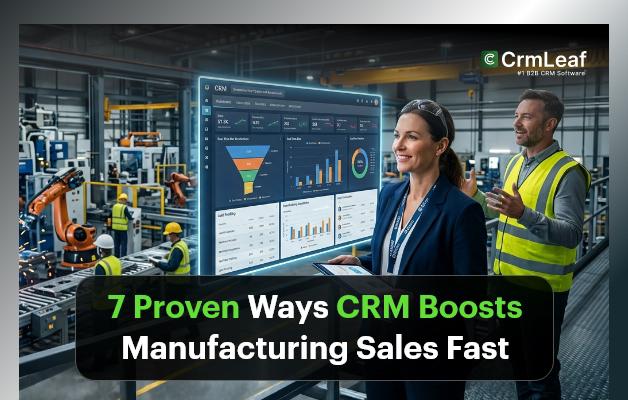
If you run a manufacturing business, you already know how tough the sales cycle can be. Long lead times, complex quotes, and multiple decision-makers make every deal a challenge. CRM for manufacturing sales is the proven solution that top manufacturers use to close more deals, faster.
In fact, according to Salesforce, CRM technology can increase sales by up to 29% and productivity by 34%. In this guide, we will show you exactly how.
Moreover, manufacturers who still rely on spreadsheets and scattered emails are leaving serious revenue on the table. Therefore, switching to a modern CRM platform like CRMLeaf is no longer optional — it is a competitive necessity.
Why CRM for Manufacturing Sales Changes Everything
First, let us understand the core problem. Manufacturing sales teams juggle leads, quotes, orders, and projects all at once. As a result, deals fall through the cracks.
A purpose-built CRM for manufacturing sales solves this by bringing every process into a single, intelligent platform. Furthermore, it gives your team the visibility and automation they need to consistently win more business.
Additionally, modern manufacturing ERP software, paired with CRM capabilities, ensures your sales and operations teams are always aligned. The result is faster deals, fewer errors, and happier customers.
1. Centralize All Your Lead and Customer Data in One Place
One of the biggest sales killers in manufacturing is fragmented data. For example, your team may have customer emails in Outlook, quotes in Excel, and order history in a separate system. When a lead calls, your salesperson wastes 10 minutes hunting for context. Consequently, the conversation suffers before it even starts.
A CRM eliminates this chaos. Specifically, it centralizes every customer interaction, purchase history, quote, and communication into a single profile.
As a result, your sales team instantly knows who they are talking to and what that customer needs. In addition, our lead management software ensures no opportunity is ever missed or forgotten.
Key benefits:
- Instant access to full customer history before every call or meeting
- No more duplicated or lost data across disconnected tools
- New team members onboard faster with a complete account context
2. Automate Follow-Ups So No Lead Ever Falls Through the Cracks
Studies consistently show that 80% of sales require at least five follow-ups. However, most salespeople give up after just two. According to HubSpot’s sales research, following up persistently is one of the top drivers of closed deals. In manufacturing, where sales cycles stretch weeks or months, consistent follow-up is therefore what separates winners from the rest.
CRM automation fixes this immediately. For instance, it automatically sends follow-up emails, sets task reminders, and triggers next steps based on the pipeline stage. Furthermore, you can set up top sales automation workflows that run 24/7 on autopilot. As a result, your team focuses only on high-value conversations.
Key benefits:
- Automated email sequences keep prospects warm without any manual effort
- Task reminders ensure every follow-up happens exactly on time
- Automation runs around the clock, even when your team is offline
3. Get Real-Time Visibility Into Your Entire Sales Pipeline
Flying blind is dangerous in any sales environment. However, in manufacturing, it is especially costly. If you do not know where every deal stands, you cannot make confident forecasts or smart resourcing decisions. Therefore, pipeline visibility is not a luxury — it is a necessity.
CRMLeaf gives sales managers a live, visual pipeline. In addition, our sales reports and analytics turn raw pipeline data into clear, actionable insights. Consequently, you can spot bottlenecks early, redirect your team’s focus, and close more deals every month. Moreover, understanding the top production bottlenecks helps your team prevent lost deals before they happen.
Key benefits:
- Accurate revenue forecasting based on live, real-time pipeline data
- Instant identification of stalled or high-risk deals in your funnel
- Sales managers can intervene early and redirect their team’s effort effectively
4. Manage Quotes, Orders, and Projects in One Platform
In manufacturing, the sale does not end when the customer says yes. Instead, the handoff from sales to operations is where most manufacturers lose the customer experience. Quotes get lost, timelines get miscommunicated, and the customer ends up frustrated before the product even ships.
An all-in-one CRM fixes this completely. Specifically, CRMLeaf connects your quote management directly to project delivery. Furthermore, when a deal closes, your operations team immediately sees project scope, timelines, and all customer requirements.
As a result, there is zero data re-entry and zero miscommunication. Additionally, a unified CRM platform ensures your entire organization stays perfectly aligned from day one.
Key benefits:
- Seamless sales-to-operations handoff with absolutely zero data re-entry
- Quotes and order details are linked directly to customer records
- Better customer experience from first contact all the way through delivery
5. Improve Team Collaboration Across Sales and Support
Manufacturing sales are rarely a solo effort. Therefore, your sales, support, project management, and leadership teams all need to stay perfectly aligned on key accounts. When these teams work in separate systems, critical information gets missed. Consequently, customers notice — and sometimes leave.
CRMLeaf acts as a shared workspace for your entire team. For example, our team management features give everyone visibility into customer notes, open tickets via our ticket management system, project status, and upcoming renewals. In addition, this alignment makes your team look sharp and professional to every single customer. As a result, customer retention improves alongside your win rate.
Key benefits:
- All teams see the same real-time customer information instantly
- Support tickets are linked directly to customer accounts and sales history
- Customers receive faster resolutions and a more cohesive overall experience
6. Use AI to Prioritize Your Best Leads and Close Faster
Not all leads deserve equal attention. Therefore, your salespeople must focus their limited time on the highest-probability prospects. According to Gartner’s CRM research, AI-enhanced CRM tools are now among the top investments for B2B sales teams. CRMLeaf’s AI-powered lead scoring analyzes engagement data and deal history to rank every lead by conversion likelihood.
As a result, your team focuses its energy precisely where it matters most. Moreover, AI can draft follow-up emails, summarise meeting notes, and flag deals that need immediate attention. Consequently, deals move faster, and your win rate improves — without adding headcount. This is why CRM for manufacturing sales with built-in AI is the new competitive standard.
Key benefits:
- AI lead scoring helps reps focus on the deals most likely to close
- AI-drafted emails save significant time and keep outreach consistent
- Predictive insights reduce guesswork and dramatically improve decision-making
7. Replace Multiple Tools With One Platform and Cut Costs
Many manufacturing businesses unknowingly pay for five to ten separate software tools that do not communicate with each other. Consequently, the total cost is staggering, and the constant switching between platforms kills team productivity. However, there is a better way.
CRMLeaf brings sales, support, project management, and HRMS integration into a single, unified platform. Furthermore, it replaces your disconnected tools at a fraction of the combined cost.
For example, see our transparent CRMLeaf pricing plans — all-inclusive with no hidden per-user or per-module fees. Additionally, it is the best CRM choice for small and growing businesses looking to scale without complexity.
CRMLeaf also serves industries beyond manufacturing — for instance, our solar CRM solution is purpose-built for solar sales teams.
Key benefits:
- Significant cost savings by replacing multiple disconnected subscriptions
- One login, one dashboard, and one source of truth for your whole business
- Faster team adoption thanks to a simpler, unified interface
The Bottom Line: CRM for Manufacturing Sales Is Now Essential
Manufacturing sales have always been complex. However, in 2026, the businesses that win will be the ones that combine great products with smart, connected systems. Therefore, a modern CRM for manufacturing sales is no longer optional — it is your most important competitive tool.
The 7 strategies above are not theoretical. In fact, they are the real, measurable results that manufacturers around the world are achieving right now. Consequently, if you want to boost revenue, eliminate chaos, and give your team a genuine edge, CRMLeaf is the platform built specifically for you.
Final Thoughts
In today’s competitive landscape, relying on outdated systems and manual processes is one of the biggest barriers to growth. Manufacturing businesses that embrace a modern CRM are not just improving sales—they are transforming how their entire organization operates.
By centralizing data, automating workflows, improving collaboration, and leveraging AI-driven insights, you create a sales engine that runs faster, smarter, and more efficiently. As a result, your team spends less time managing complexity and more time closing high-value deals.
Most importantly, adopting a solution like CRMLeaf positions your business for long-term scalability. Whether you are looking to increase conversion rates, shorten sales cycles, or enhance customer relationships, the right CRM system provides the foundation for sustainable success.
Frequently Asked Questions
1. What is CRM in manufacturing?
CRM (Customer Relationship Management) in manufacturing helps manage customer data, track sales activities, and improve communication across the sales pipeline.
2. How does CRM improve manufacturing sales?
CRM helps streamline lead management, automate follow-ups, and provide real-time insights, leading to faster and more efficient sales processes.
3. Why is CRM important for manufacturing companies?
It enhances customer relationships, improves sales forecasting, and ensures better coordination between sales and production teams.
4. Can CRM help increase lead conversion rates?
Yes, CRM systems track leads effectively and provide data-driven insights that help sales teams convert more prospects into customers.
5. What features should a manufacturing CRM include?
Key features include sales tracking, inventory integration, reporting tools, automation, and customer data management.
6. How does CRM support sales team productivity?
CRM automates repetitive tasks, organizes customer information, and helps sales teams focus on closing deals faster.
7. Is CRM suitable for small manufacturing businesses?
Yes, CRM solutions are scalable and can benefit both small and large manufacturing businesses by improving sales efficiency.
8. How does CRM help in customer retention?
CRM stores customer history and preferences, enabling personalized communication and better customer service.
9. Can CRM integrate with other manufacturing tools?
Yes, most CRM systems can integrate with ERP, inventory management, and accounting software for seamless operations.
10. How quickly can CRM impact manufacturing sales?
With proper implementation, CRM can start showing improvements in sales performance within a few weeks to months.