⚡ TL;DR
- You can plan for peak season with the CRM data you already have: past won deals, open pipeline value, quote and proposal activity, and follow-up tasks.
- CrmLeaf gives you the records and reports for this (lead and deal reports, a CRM dashboard and a pipeline board with stage totals). You still read the numbers and decide.
- CrmLeaf does not include an AI demand forecast. We do not claim one here.
- Deal management and reports are in the Basic plan ($9 per user per month, $8.10 on annual billing). Workflow Automation for alerts is in the Premium plan ($29, or $24.80 on annual billing).
Plans and prices were checked on 4 November 2026. We make CrmLeaf, so test every step with your own data during the 15-day free trial, no card needed.
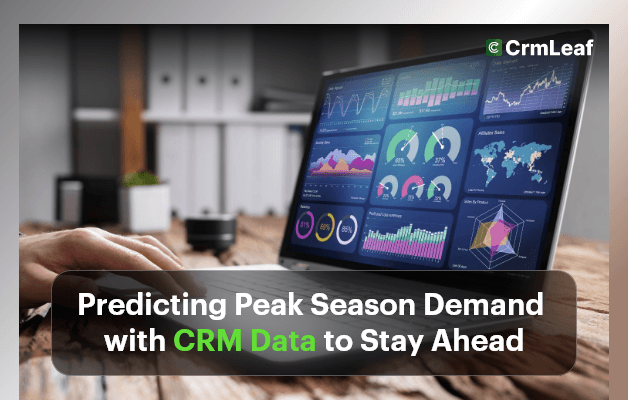
Ever been caught off guard by a sudden surge in orders during the holidays? Or left with unsold stock after expecting a peak that never came? Predicting peak season demand is not magic. It is a habit of reading your own sales history and your open pipeline before the season starts, then acting early.
This guide shows how to predict peak season demand with CRM data, what each step needs from your CRM, and where CrmLeaf helps. It suits retail, manufacturing, distribution and service teams that sell to repeat customers. We describe only features that CrmLeaf documents, and we say which plan each one needs.
Business Need & Importance
Peak seasons, like holiday shopping, back-to-school or fiscal year-end, can make or break a business. Small and medium-sized businesses often have to balance stock, staff and promotions during these high-demand windows, with little room for error.
Manual methods and scattered spreadsheets make this harder. Sales history sits in one file, open quotes in another, and nobody sees both at once. A CRM puts them on one set of records, so you can compare last year with this year's pipeline.
Why it matters:
- Retailers need the right products in the right quantities. Overstock leads to markdowns, and understock means lost sales.
- Manufacturers must line up raw material orders with expected order volumes to avoid delays and waste.
- E-commerce sellers must plan logistics and warehouse work early enough to meet delivery promises.
Real-time CRM data does not predict the future by itself. It does give you facts to forecast from: actual customer trends, past buying behavior, open deals and seasonal patterns. A forecast built on those facts is easier to explain and easier to correct than a guess.
Best Practices & Actionable Tips
Here is how teams use CRM data to prepare for a peak, and what to do in CrmLeaf at each step. The forecasting itself is your judgment, supported by reports. CrmLeaf does not generate a demand forecast for you.
Analyze Historical Sales Patterns
Start with your last two or three peak seasons. Pull the won deals for those weeks and note which products sold, which customer groups bought them and when orders arrived.
In CrmLeaf, sales reports and the lead and deal reports show deal counts, average deal size and won deals, and you can export the data to a spreadsheet. Split the results by sales rep, source or product so that you can see repeat patterns, not just one big total.
- Pick the same date range for each past season.
- Note the week the first orders came in, not just the total.
- Write down any one-off event, such as a big promotion, so you do not repeat its spike by mistake.
Track Real-Time Customer Behavior
Your CRM shows intent signals through activity on records. In CrmLeaf these include proposals that clients opened (the last viewed time is stored), proposal statuses of waiting, accepted or declined, and email sent from a Deal with Sent, Delivered, Opened and Replied status when you connect a mailbox through the email integration.
CrmLeaf does not track website behavior or add-to-cart actions, so those signals have to come from your store or web tools. Add them to your planning sheet next to the CRM numbers.
For prioritizing buyers, CrmLeaf supports manual lead scoring through stages, categories and notes. It does not score leads automatically. Our guide on using lead scoring to prioritize almost-close deals explains how to set up a simple manual system.
Integrate CRM with Inventory & Supply Chain
Demand numbers only help if procurement can see them. The simplest approach is a shared weekly view: open deals by expected close date on one side, current stock and supplier lead times on the other.
The deal management pipeline board shows stage totals, so you can see how much value sits in late stages. Share that figure with whoever buys stock. Linking CrmLeaf to an ERP or accounting system is an Enterprise plan item, so confirm it with the CrmLeaf team before you plan around it.
Build a Simple Demand Forecast from CRM Data
Predictive analytics can be as simple as a trend line in a spreadsheet. Take the past seasons you pulled earlier, then adjust for this year's open pipeline and any change in lead volume.
- Take last year's peak sales as a baseline.
- Compare this year's open pipeline at the same point in the calendar with last year's.
- Raise or lower the baseline by that difference, then add a safety margin for stock.
- Review the result with sales, purchasing and operations before you commit.
CrmLeaf does not include built-in AI forecasting or a predictive demand module. The Ask AI and writing assistants described on the AI page are add-ons enabled per company, so confirm they are in your plan, and they do not forecast demand.
Adjust Marketing & Sales Campaigns in Real Time
When pipeline is lower than your forecast, act early. Review which segments have gone quiet and give your team a follow-up list. When it is higher than expected, tell purchasing and shift effort to the segments closing fastest.
CrmLeaf does not run marketing campaigns automatically. What it can do is create follow-up tasks and send notifications through Workflow Automation (Premium plan), using a When, If, Then rule on records such as Leads, Deals and Clients.
Create a Demand Calendar with Alerts
Build a simple calendar with the dates that matter: when to order stock, when to hire seasonal staff and when to start promotions. Work backward from the peak date.
With workflow automations on the Premium plan, you can set a rule that sends an email, assigns an owner, creates a follow-up task or sends an in-app notification when a record meets a condition. Tasks for each milestone can also live in task management, so the calendar has an owner for every date.
Plan Your Peak Season in CrmLeaf
Want to try this on your own pipeline? Start a 15-day free trial with no card, or compare plans first.
Start your free trial or see CrmLeaf plans and prices.
Example: Preparing for a Year-End Sale
Example scenario (illustrative, not a customer). A retailer of small electronics wants to prepare for a year-end sale. It has no results to report yet, so the example shows the steps only.
- The sales lead exports last year's won deals for November and December, grouped by product.
- The team checks this year's open deals and proposals and finds which ones are waiting on the client.
- Purchasing uses both views to set a stock target with a safety margin, and writes down the assumptions.
- A weekly review compares actual orders with the plan and adjusts the next order.
The value of this approach is the routine, not a single number. Each season adds another data point, and your next forecast gets a little closer to reality. Any figures you see from your own run should come from your own records.
For examples of real CrmLeaf customers, see the customers page.
Key Takeaways & Closing
Predicting peak season demand starts with clean history and an honest look at the pipeline. Use your CRM to see past sales, open deals and client activity in one place, then turn that into a plan for stock, staff and promotions.
- Use reports to find the patterns in past peaks.
- Compare this year's open pipeline with last year's at the same date.
- Share stage totals with purchasing every week.
- Set alerts and follow-up tasks so the plan has owners and dates.
- Check the result after the season and keep the lessons.
CrmLeaf supplies the records, reports and alerts. The forecast stays in your hands, which keeps it transparent and easy to adjust.
Sources
Pages opened and checked on 4 November 2026:
- CrmLeaf: pricing and plans
- CrmLeaf: sales reports
- CrmLeaf: workflow automations
- CrmLeaf: AI features
Plans and prices checked on the CrmLeaf pricing page on 4 November 2026. Facts checked against CrmLeaf pricing and product documentation.