
⚡ TL;DR
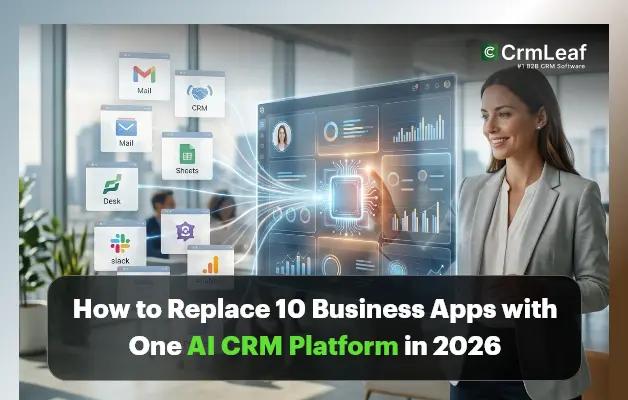
Managing multiple business applications creates data silos, increases software costs, and slows down productivity. Instead of juggling separate tools for CRM, HR, payroll, project management, inventory, helpdesk, and workflow automation, businesses are increasingly adopting a single AI CRM platform to manage everything from one place.
This guide explains how replacing up to 10 standalone business applications with one unified AI CRM platform can simplify operations, improve team collaboration, automate repetitive tasks, reduce expenses, and provide real-time business insights. You’ll also learn which business tools can be consolidated, the key benefits of AI-powered automation, and what features to look for when choosing an all-in-one business management solution in 2026.
Modern businesses rely on dozens of software applications to manage daily operations. Sales teams use one CRM, HR manages employees through another system, finance processes payroll separately, support teams rely on helpdesk software, and project managers coordinate work using different collaboration tools.
While each application may solve a specific problem, using multiple disconnected systems often creates more challenges than benefits. Teams struggle with duplicate data, manual updates, inconsistent reporting, higher subscription costs, and reduced productivity.
In 2026, businesses are shifting toward a new approach: replacing multiple standalone applications with one AI-powered CRM platform that centralizes operations, automates workflows, and provides real-time visibility across every department.
This guide explains why organizations are making this transition, which business applications can be consolidated, the benefits of unified operations, and how AI CRM platforms are transforming modern businesses.
Why Businesses Are Moving Away from Multiple Software Tools
Over the last decade, SaaS applications have become easier to adopt. As companies grew, every department selected specialized software that addressed its immediate needs.
A typical business might use:
- CRM software for sales
- HRMS software for employee management
- Payroll software
- Project management software
- Helpdesk software
- Inventory management software
- Manufacturing management software
- Accounting software
- Marketing automation software
- Spreadsheet applications
Although these tools are effective individually, they rarely communicate seamlessly with one another.
The result is fragmented information, repetitive manual work, and inefficient business processes.
The Hidden Cost of Using Multiple Business Applications
Many organizations underestimate the true cost of managing disconnected software.
Duplicate Data Entry
Customer information often needs to be entered into multiple systems, increasing administrative work and the likelihood of errors.
Higher Subscription Costs
Paying for numerous SaaS subscriptions can significantly increase operational expenses over time.
Lack of Real-Time Visibility
Managers often need to gather reports from different platforms before making informed decisions.
Integration Challenges
Maintaining integrations between multiple applications requires ongoing technical effort and additional expenses.
Reduced Employee Productivity
Employees waste valuable time switching between systems instead of focusing on strategic work.
The Rise of AI CRM Platforms
Modern AI CRM platforms have evolved beyond traditional customer relationship management.
Instead of managing only leads and contacts, today’s AI-powered platforms combine multiple business functions into a single ecosystem.
These platforms integrate:
- Customer Relationship Management
- Sales Automation
- Project Management
- HRMS
- Payroll
- Helpdesk
- Inventory
- Manufacturing
- Reporting
- Workflow Automation
- AI-powered insights
This unified approach allows every department to work from the same source of truth.
10 Business Applications You Can Replace with One AI CRM Platform
CRM Software
Manage leads, contacts, opportunities, customer interactions, and sales pipelines from one centralized dashboard.
Benefits
- Lead tracking
- Contact management
- Sales forecasting
- Pipeline visualization
- Opportunity management
Project Management Software
Coordinate projects, assign tasks, monitor deadlines, and track progress without relying on separate project management tools.
Features include:
- Task management
- Kanban boards
- Milestones
- Team collaboration
- Time tracking
HR Management Software
Manage your workforce throughout the employee lifecycle.
Capabilities include:
- Employee database
- Attendance
- Leave management
- Performance tracking
- Document management
Payroll Software
Simplify payroll processing through automated salary calculations and statutory compliance support.
Typical features include:
- Salary processing
- Payslip generation
- Tax calculations
- Reimbursements
- Payroll reports
Helpdesk Software
Deliver better customer support using an integrated ticket management system.
Key capabilities include:
- Ticket creation
- SLA tracking
- Knowledge base
- Customer communication
- Resolution reporting
Inventory Management Software
Monitor inventory across warehouses while reducing manual stock management.
Features include:
- Stock tracking
- Purchase orders
- Warehouse management
- Inventory reports
- Product management
Manufacturing Software
Manufacturers can streamline production planning and operations from a single platform.
Typical capabilities:
- Production planning
- Bills of materials
- Work orders
- Material tracking
- Production reporting
Workflow Automation Software
AI-powered automation removes repetitive tasks by connecting business processes.
Examples include:
- Automatic lead assignment
- Approval workflows
- Notifications
- Email automation
- Task creation
- Follow-up reminders
Business Analytics Software
Generate real-time dashboards without exporting data from multiple systems.
Dashboards provide insights into:
- Sales
- Projects
- Employee productivity
- Customer support
- Revenue
- Business growth
Team Collaboration Tools
Instead of switching between communication platforms and task managers, teams collaborate directly within one system.
How AI Makes Business Operations Smarter
Artificial intelligence enhances every stage of business operations.
- Intelligent Lead Scoring: AI identifies high-value prospects based on engagement, behavior, and historical conversion patterns.
- Automated Task Recommendations: Routine follow-ups, reminders, and approvals can be generated automatically.
- Predictive Business Insights: AI analyzes trends to forecast sales performance, project risks, and operational bottlenecks.
- Faster Customer Support: AI assists support teams by categorizing tickets, suggesting responses, and identifying recurring issues.
- Improved Decision-Making: Executives gain a consolidated view of business performance without waiting for manual reports.
Benefits of Using One AI CRM Platform
Businesses adopting a unified platform often experience:
- Reduced software costs
- Faster business processes
- Better collaboration
- Improved customer experience
- Centralized data management
- Increased operational efficiency
- Simplified reporting
- Stronger data security
- Easier scalability
- Better decision-making
Real-World Business Example
Imagine a manufacturing company receiving a new sales inquiry.
Instead of manually updating multiple systems:
- A lead is created automatically.
- The sales team tracks the opportunity.
- Once approved, a project is generated.
- Inventory availability is checked.
- Manufacturing receives production instructions.
- HR allocates resources.
- Payroll captures employee work hours.
- Finance prepares invoices.
- Customer support monitors post-sales requests.
- Management tracks every stage through a unified dashboard.
This connected workflow eliminates duplicate work and improves operational efficiency.
Why Unified Data Matters
When every department works within the same platform, data becomes significantly more valuable.
Benefits include:
- One customer record
- Shared employee information
- Unified project visibility
- Real-time financial reporting
- Consistent business analytics
Instead of searching across multiple applications, teams access everything from one centralized system.
Choosing the Right AI CRM Platform
When evaluating solutions, consider whether the platform provides:
- CRM
- Sales automation
- Workflow automation
- Project management
- HRMS
- Payroll
- Helpdesk
- Inventory management
- Manufacturing support
- AI capabilities
- Reporting dashboards
- Custom workflows
- Role-based permissions
- Mobile accessibility
- API integrations
- Scalable architecture
Selecting a platform that supports multiple departments can reduce software sprawl and simplify long-term growth.
How CRMLeaf Supports Unified Business Operations
CRMLeaf is designed as a unified AI-powered business platform that brings together customer relationship management, sales automation, project management, HRMS, payroll, helpdesk, inventory, manufacturing, and workflow automation within a single ecosystem.
Rather than requiring businesses to purchase and maintain separate applications, CRMLeaf enables teams to manage operations from one centralized platform with shared data, automated workflows, and real-time reporting.
By reducing application switching and consolidating business processes, organizations can improve collaboration, streamline operations, and make faster, data-driven decisions.
Future of AI CRM Platforms
The next generation of AI CRM platforms will continue to evolve with capabilities such as:
- Autonomous workflow automation
- Predictive business analytics
- AI-powered customer service
- Intelligent resource allocation
- Voice-enabled business assistants
- Real-time process optimization
- Cross-department automation
- Advanced forecasting
- Personalized customer engagement
Businesses that embrace unified AI platforms today will be better positioned to scale efficiently and adapt to future technological advancements.
Conclusion
Managing ten different business applications is no longer necessary for growing organizations. A unified AI CRM platform can centralize sales, projects, HR, payroll, customer support, inventory, and operational workflows while reducing costs and improving efficiency.
As businesses continue to prioritize automation and connected data in 2026, adopting an integrated AI CRM solution can simplify operations, enhance collaboration, and provide the insights needed to make faster, more informed decisions.
Whether you’re a startup, a growing business, or an enterprise, consolidating your software ecosystem into one AI-powered platform can create a stronger foundation for sustainable growth.