
⚡ TL;DR
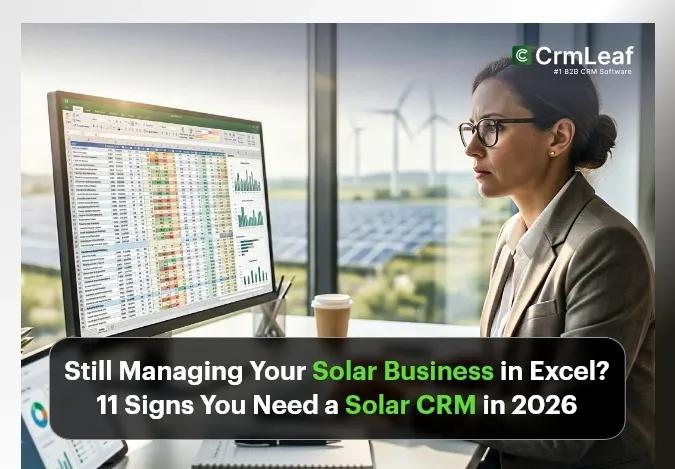
If your solar company still manages leads, site surveys, quotations, project execution, inventory, and customer follow-ups using Excel spreadsheets, you’re likely wasting valuable time and revenue.
As your business grows, spreadsheets become harder to maintain, collaboration suffers, and important customer information gets scattered across emails, WhatsApp chats, and multiple files.
A dedicated Solar CRM centralizes your entire workflow – from capturing leads to generating proposals, tracking installations, managing inventory, collecting payments, and providing after-sales support.
In this guide, we’ll explore the 11 biggest signs your solar business has outgrown Excel and explain how a modern Solar CRM like CrmLeaf helps streamline operations, improve customer experience, and support scalable growth.
The solar industry is experiencing unprecedented growth. Residential, commercial, and industrial customers are investing in clean energy faster than ever, while government incentives and rising electricity costs continue to drive demand.
For solar EPC companies, installers, and contractors, this growth creates tremendous opportunities – but it also introduces operational complexity.
Every new inquiry brings additional tasks:
- Qualifying leads
- Scheduling site surveys
- Preparing system designs
- Creating proposals
- Managing Bills of Materials (BOQs)
- Coordinating installation teams
- Tracking inventory
- Managing vendors
- Raising invoices
- Following up on payments
- Providing warranty and maintenance support
Many growing solar businesses attempt to manage these processes with Excel spreadsheets. At first, this approach seems affordable and flexible. However, as customer volume increases, spreadsheets quickly become difficult to maintain, prone to errors, and inefficient for collaboration.
A missed follow-up, an outdated quotation, or an inventory mismatch can delay installations, reduce customer satisfaction, and directly impact revenue.
This is where a purpose-built Solar CRM becomes essential.
Unlike a generic CRM, a Solar CRM is designed around the complete solar sales and project lifecycle. It helps your team manage every stage – from the first inquiry to installation, invoicing, and ongoing service – within a single, centralized platform.
CrmLeaf brings these capabilities together by combining customer relationship management, project tracking, proposal management, workflow automation, inventory management, vendor coordination, and service support into one unified solution tailored for solar businesses.
If you’re unsure whether your business has reached the point where spreadsheets are holding you back, the following signs will help you decide.
Why Excel Stops Working for Growing Solar Companies
Excel remains one of the most widely used business tools because it’s familiar, flexible, and inexpensive. Many solar businesses begin with spreadsheets to track customer inquiries, quotations, project schedules, and expenses.
However, Excel was never designed to manage complex, collaborative business operations.
As your company grows, you’ll likely encounter several challenges:
| Business Need | Excel | Solar CRM |
| Lead Management | Manual | Automated |
| Sales Pipeline | Limited | Visual Pipeline |
| Site Survey Tracking | Manual | Built-in Workflow |
| Proposal Management | Separate Files | Centralized |
| BOQ Management | Manual | Linked to Projects |
| Inventory Tracking | Difficult | Real-Time |
| Vendor Coordination | Email & Excel | Integrated |
| Installation Tracking | Manual Updates | Live Status |
| Payment Tracking | Separate Sheets | Automated |
| Customer Service | Scattered | Unified Ticketing |
| Team Collaboration | File Sharing | Real-Time |
| Reports & Analytics | Manual | Instant Dashboards |
The more spreadsheets you create, the more difficult it becomes to maintain a single source of truth. Teams may unknowingly work with outdated information, duplicate records, or overlook critical tasks.
A Solar CRM addresses these issues by providing a centralized platform where sales, engineering, procurement, installation, and customer support teams work from the same real-time data.
What Is a Solar CRM?
A Solar CRM is customer relationship management software built specifically for solar installers, EPC companies, and renewable energy businesses.
Rather than focusing only on customer contacts, it manages the complete operational lifecycle of a solar project.
A modern Solar CRM typically includes:
- Lead capture and qualification
- Sales pipeline management
- Site survey scheduling
- Technical assessment tracking
- Solar proposal generation
- BOQ management
- Project planning
- Inventory tracking
- Vendor procurement
- Installation scheduling
- Invoice generation
- Payment tracking
- Service ticket management
- Annual Maintenance Contract (AMC) management
- Performance reporting and analytics
By connecting these processes in one platform, businesses reduce manual work, improve collaboration, and gain better visibility into every project.
11 Signs You’ve Outgrown Excel
Every growing solar business reaches a stage where spreadsheets begin to limit efficiency rather than support it. If any of the following situations sound familiar, it may be time to consider a dedicated Solar CRM.
1. Your Team Is Losing Leads
A customer submits an inquiry through your website. Another contacts you via WhatsApp. A third calls your sales representative directly.
Without a centralized system, these leads often end up in different spreadsheets – or worse, they’re never recorded at all.
Missing or delayed follow-ups reduce conversion rates and give competitors an opportunity to win business.
A Solar CRM automatically captures leads from multiple channels and assigns them to the right sales representatives, ensuring every opportunity is tracked from the first interaction.
2. You’re Spending Hours Creating Solar Proposals
One of the biggest bottlenecks for growing solar companies is proposal creation.
A typical proposal requires information from multiple departments:
- Customer information
- Site survey details
- Solar panel specifications
- Inverter selection
- Energy consumption analysis
- Bill of Materials (BOQ)
- Pricing
- Installation timeline
- Warranty details
- Terms and conditions
When this information lives across Excel sheets, Word documents, PDFs, and emails, preparing a proposal becomes time-consuming and error-prone.
Imagine your sales representative quoting a 10 kW system while the engineering team designed an 8 kW system. Or using outdated pricing because someone forgot to update the spreadsheet.
These mistakes don’t just delay projects – they can reduce customer trust and hurt profitability.
How CrmLeaf Helps
CrmLeaf centralizes proposal management by connecting customer data, site survey information, BOQs, and project details in one place. Sales teams can prepare accurate proposals faster while ensuring engineering and pricing remain aligned.
3. Your Sales Team Has No Clear Pipeline
Ask three sales representatives about the status of a customer, and you may receive three different answers.
One believes the proposal was sent.
Another says the customer requested changes.
A third thinks the deal has already been closed.
Without visibility into the sales pipeline, managers struggle to answer basic questions like:
- How many qualified leads are in the pipeline?
- Which deals are likely to close this month?
- Which salesperson performs best?
- Where are deals getting stuck?
- What is the expected revenue?
Excel cannot provide real-time pipeline visibility without constant manual updates.
What a Solar CRM Does Better
A Solar CRM gives every opportunity a defined stage, such as:
Lead
   ↓
Qualified Lead
   ↓
Site Survey
   ↓
Technical Assessment
   ↓
Proposal Sent
   ↓
Negotiation
   ↓
Customer Approval
   ↓
Project Started
   ↓
Installation
   ↓
Completed
CrmLeaf provides a visual sales pipeline that helps managers monitor deal progress, identify bottlenecks, and forecast revenue with greater confidence.
4. Site Survey Information Gets Lost
Every successful solar installation begins with an accurate site survey.
Your engineering team records information such as:
- Roof dimensions
- Roof type
- Panel orientation
- Shading analysis
- GPS location
- Photographs
- Electrical connection details
- Customer requirements
When these details are stored in folders, WhatsApp chats, or local devices, finding the correct information later becomes difficult.
Missing survey details often lead to:
- Incorrect system sizing
- Proposal revisions
- Delayed installations
- Additional site visits
- Increased project costs
Why It Matters
A missing photograph or an outdated measurement can delay an entire installation schedule.
How CrmLeaf Solves This
CrmLeaf links every site survey directly to the customer and project record. Teams can upload photos, technical notes, documents, and survey findings so everyone works from the same information throughout the project lifecycle.
5. Inventory Is Always a Guess
Solar projects depend on timely availability of materials.
These include:
- Solar panels
- Inverters
- Mounting structures
- Batteries
- DC cables
- AC cables
- Connectors
- Junction boxes
- Safety equipment
Many businesses still maintain inventory in Excel.
The result?
- Duplicate purchases
- Material shortages
- Overstocking
- Installation delays
- Procurement confusion
A single spreadsheet rarely reflects real-time stock movement across multiple projects.
CRM vs Excel
| Inventory Task | Excel | CrmLeaf Solar CRM |
| Stock Visibility | Manual | Real-Time |
| Material Allocation | Manual | Project-Based |
| Purchase Tracking | Separate Sheets | Connected Workflow |
| Low Stock Alerts | No | Yes |
| Inventory Reports | Manual | Automated |
| Material History | Difficult | Complete Audit Trail |
With CrmLeaf, inventory is connected to active projects, making it easier to reserve materials, monitor stock levels, and coordinate procurement.
6. Installation Projects Are Difficult to Track
Winning a project is only the beginning.
Execution involves multiple moving parts:
- Material allocation
- Team scheduling
- Vendor coordination
- Customer communication
- Installation milestones
- Quality inspections
- Documentation
- Final handover
When these activities are managed through spreadsheets, phone calls, and emails, project visibility quickly disappears.
Managers often ask:
- Has installation started?
- Are materials delivered?
- Is the inspection complete?
- Which projects are delayed?
- Which teams are available?
Finding answers shouldn’t require multiple phone calls.
A Better Approach
CrmLeaf allows project managers to monitor every installation stage through a centralized dashboard. Teams can update milestones, assign responsibilities, attach documents, and track progress in real time, reducing delays and improving coordination.
7. Customer Communication Is Scattered
Customers expect timely updates throughout their solar journey.
They frequently ask questions like:
- Has my proposal been approved?
- When is the installation scheduled?
- Has my inverter been delivered?
- When will I receive my invoice?
- Who should I contact for service?
If conversations are spread across:
- Gmail
- Outlook
- Phone calls
- SMS
- Personal notes
then important information is easy to miss.
Poor communication often results in:
- Repeated customer queries
- Missed follow-ups
- Frustrated customers
- Negative online reviews
How CrmLeaf Improves Communication
CrmLeaf keeps customer interactions, emails, documents, project updates, and support history connected to a single customer profile. This gives every team member the context they need to provide faster, more consistent service.
8. Reporting Takes Days Instead of Minutes
Business decisions rely on accurate data.
Yet many solar companies spend hours – or even days – preparing reports manually.
Common reports include:
- Monthly sales
- Revenue forecasts
- Project completion rates
- Installation performance
- Inventory valuation
- Lead conversion
- Sales representative performance
- Pending invoices
- Outstanding payments
Each report often requires exporting multiple Excel files, checking formulas, and validating numbers.
By the time the report is finished, the data may already be outdated.
With CrmLeaf
CrmLeaf provides real-time dashboards and analytics that help business owners monitor KPIs, track sales performance, review project progress, and make informed decisions without manual spreadsheet work.
9. Your Team Struggles to Manage After-Sales Service
For many solar companies, the customer journey doesn’t end after installation. In fact, long-term relationships are built through reliable after-sales support.
Customers may contact your team for:
- Warranty claims
- System performance issues
- Inverter faults
- Annual Maintenance Contracts (AMC)
- Preventive maintenance
- Panel cleaning schedules
- Battery replacement
- Net metering assistance
If these requests are tracked in Excel or WhatsApp, it’s easy to miss service deadlines or lose customer history.
Common problems include:
- Duplicate service requests
- Missed maintenance visits
- Slow response times
- Poor customer satisfaction
- Lost AMC renewal opportunities
How CrmLeaf Helps
CrmLeaf includes service and ticket management capabilities that allow support teams to:
- Create and assign service tickets
- Track ticket status
- Maintain complete service history
- Schedule AMC visits
- Record maintenance activities
- Improve response times
Having every interaction tied to the customer profile ensures consistent and efficient support.
10. Your Team Spends More Time Updating Excel Than Selling
Every manual update adds up.
Sales representatives often spend valuable hours:
- Updating lead sheets
- Revising quotations
- Sharing project status
- Reporting daily activities
- Updating customer records
- Following up through multiple tools
This administrative workload reduces the time available for selling and customer engagement.
Hidden Costs of Manual Processes
Even if Excel itself is inexpensive, the hidden operational costs are significant:
| Manual Activity | Business Impact |
| Updating spreadsheets | Reduced selling time |
| Searching for customer data | Slower response |
| Duplicate data entry | More errors |
| Manual report creation | Delayed decisions |
| Re-entering project information | Lower productivity |
| Tracking tasks manually | Missed deadlines |
When every department maintains separate spreadsheets, employees spend more time managing data than moving projects forward.
CrmLeaf Advantage
CrmLeaf eliminates duplicate data entry by connecting sales, projects, inventory, finance, and customer service within a single platform. Information entered once becomes available throughout the workflow, reducing manual effort and improving accuracy.
11. You Can’t Scale Your Solar Business with Confidence
Many solar businesses reach a growth ceiling – not because demand is lacking, but because internal processes can’t keep up.
As your business expands, you may face:
- More sales representatives
- More installation teams
- More warehouses
- More vendors
- More service requests
- More customer inquiries
- More simultaneous projects
Managing this complexity through spreadsheets becomes increasingly difficult.
Typical signs include:
- Projects slipping through the cracks
- Inconsistent customer experiences
- Delayed decision-making
- Difficulty onboarding new employees
- Limited visibility into business performance
At this stage, investing in a Solar CRM is no longer optional – it’s a strategic necessity.
What Does the Ideal Solar CRM Workflow Look Like?
A purpose-built Solar CRM should connect every department and every stage of the customer journey.
Lead Capture
      ↓
Lead Qualification
      ↓
Site Survey
      ↓
Technical Assessment
      ↓
Solar Design
      ↓
Proposal & BOQ
      ↓
Customer Approval
      ↓
Project Creation
      ↓
Material Planning
      ↓
Inventory Allocation
      ↓
Vendor Procurement
      ↓
Installation Scheduling
      ↓
Installation Execution
      ↓
Quality Inspection
      ↓
Invoice Generation
      ↓
Payment Collection
      ↓
Warranty Registration
      ↓
AMC & Service Support
Instead of using separate spreadsheets, emails, and messaging apps, each stage flows seamlessly into the next. This creates a single source of truth for your sales, engineering, procurement, installation, finance, and support teams.
Why More Solar EPC Companies Are Switching to CRM Software
The solar industry has become more competitive. Customers expect faster responses, accurate proposals, transparent communication, and timely project delivery.
Companies that rely on manual processes often struggle to meet these expectations.
Modern Solar CRM software helps businesses:
- Respond to inquiries faster
- Improve lead conversion rates
- Reduce proposal turnaround time
- Coordinate installation teams more effectively
- Track inventory in real time
- Monitor project milestones
- Automate routine tasks
- Deliver better customer experiences
The result is a more organized operation that can support sustainable growth.
How CrmLeaf Supports the Entire Solar Business Lifecycle
Unlike generic CRM solutions that focus mainly on contact management, CrmLeaf is designed to support the operational needs of solar EPC companies.
Lead & Sales Management
- Capture leads from multiple channels
- Organize sales pipelines
- Assign leads automatically
- Schedule follow-ups
- Monitor conversion rates
Proposal & BOQ Management
- Manage customer requirements
- Organize proposal documents
- Track proposal revisions
- Associate BOQs with projects
- Maintain document history
Project Management
- Create projects after approval
- Assign responsibilities
- Track milestones
- Monitor deadlines
- Collaborate across teams
Inventory & Procurement
- View available stock
- Allocate materials to projects
- Track procurement requests
- Coordinate with vendors
- Reduce material shortages
Finance & Payment Tracking
- Generate invoices
- Track payment status
- Monitor outstanding balances
- Improve cash flow visibility
Service & AMC Management
- Log customer issues
- Schedule maintenance visits
- Track warranty requests
- Manage AMC renewals
- Maintain complete service records
By bringing these functions together, CrmLeaf reduces the need to switch between multiple tools and spreadsheets, helping teams work more efficiently.
Best Practices for Moving from Excel to a Solar CRM
Migrating to a CRM doesn’t have to be disruptive. A structured approach can help your team transition smoothly.
1. Organize Existing Data: Before importing information, remove duplicate records, correct incomplete entries, and standardize formats.
2. Map Your Sales Process: Define each stage of your sales and project workflow so it can be replicated within the CRM.
3. Import Data in Phases: Start with customer and lead data, then add projects, inventory, and service records.
4. Train Every Department: Ensure sales, engineering, procurement, installation, finance, and support teams understand how the CRM fits into their daily work.
5. Automate Repetitive Tasks: Set up automated reminders, follow-ups, notifications, and workflows to reduce manual effort.
6. Measure Performance: Track key metrics such as lead response time, proposal turnaround, project completion rates, customer satisfaction, and revenue growth to evaluate the CRM’s impact.
The ROI of Replacing Excel with a Solar CRM
Switching from spreadsheets to a dedicated Solar CRM isn’t just a technology upgrade – it’s an investment in operational efficiency.
Potential business benefits include:
| Area | Expected Improvement |
| Lead Response | Faster follow-ups |
| Sales Conversion | Higher close rates |
| Proposal Creation | Reduced turnaround time |
| Project Tracking | Better visibility |
| Inventory Accuracy | Fewer stock issues |
| Team Productivity | Less manual work |
| Customer Satisfaction | Improved communication |
| Business Reporting | Real-time insights |
While the exact results vary by business, companies that centralize their operations often experience better collaboration, fewer manual errors, and greater scalability.
Key Takeaways
If your solar business relies heavily on Excel, the warning signs are difficult to ignore:
- Leads are slipping through the cracks.
- Proposal creation is slow and error-prone.
- Sales visibility is limited.
- Site survey information is scattered.
- Inventory is difficult to manage.
- Installation progress lacks transparency.
- Customer communication is fragmented.
- Reporting takes too long.
- After-sales service is inconsistent.
- Employees spend more time updating spreadsheets than serving customers.
- Scaling operations becomes increasingly challenging.
A dedicated Solar CRM addresses these issues by connecting every stage of the solar business lifecycle – from the first customer inquiry to installation, invoicing, and long-term service support.
Choosing the Right Solar CRM
Not all CRM software is built for solar businesses. A generic CRM may help manage contacts, but it often lacks the tools needed to handle site surveys, BOQs, project execution, inventory, and after-sales service.
When evaluating a Solar CRM, look for features such as:
- Lead and pipeline management
- Site survey tracking
- Proposal and BOQ management
- Project and installation tracking
- Inventory and procurement management
- Invoice and payment tracking
- Service ticket and AMC management
- Real-time dashboards and reporting
- Workflow automation
- Mobile accessibility
Choosing software that supports your complete business workflow will save time, improve collaboration, and make future growth easier.
Why CrmLeaf Is a Smart Choice for Solar Companies
CrmLeaf is built specifically to help solar EPC companies manage their entire business from a single platform.
With CrmLeaf, you can:
- Capture and manage leads
- Track your sales pipeline
- Create and manage proposals
- Monitor project progress
- Manage inventory and vendors
- Track invoices and payments
- Handle customer service and AMC requests
- Access real-time reports and dashboards
Instead of juggling multiple spreadsheets and disconnected tools, your team can collaborate using one centralized system.
Conclusion
Excel is a great starting point, but it isn’t designed to manage the growing complexity of a solar business.
If you’re losing leads, spending too much time creating proposals, struggling to track projects, or relying on multiple spreadsheets, it’s a strong indication that your business has outgrown manual processes.
A dedicated Solar CRM helps you centralize sales, project management, inventory, finance, and customer support – allowing your team to work more efficiently and deliver a better customer experience.
As your business grows, adopting the right Solar CRM can help you streamline operations, improve productivity, and scale with confidence.